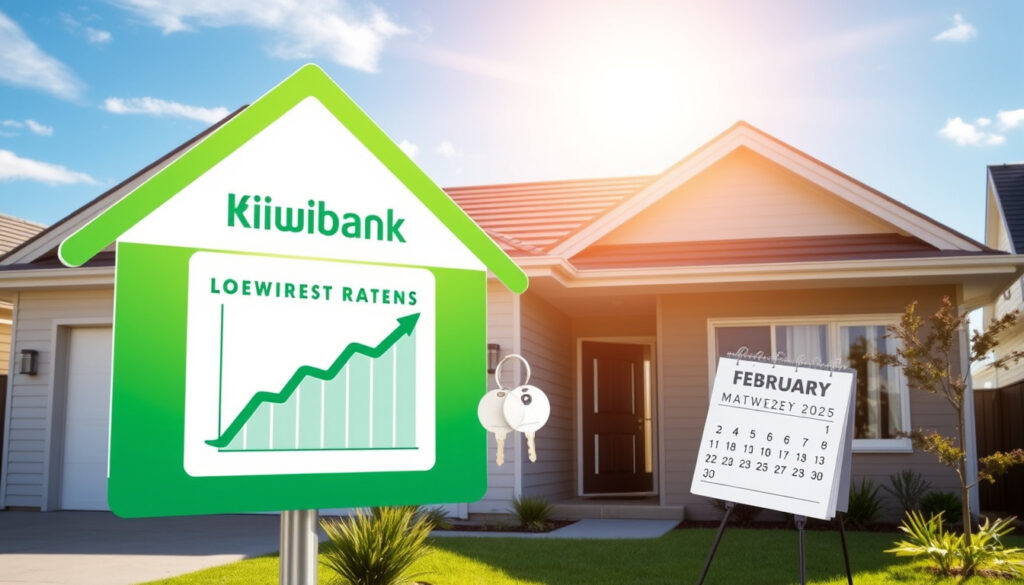
Kiwibank Lowers Home Loan Rates Effective 24 February 2025
Home borrowers watching the Reserve Bank’s moves closely got some welcome relief earlier this year when Kiwibank announced cuts to its lending rates. The bank lowered variable rates multiple times in 2025, bringing the floating rate down to 5.65% by December, while also easing the mortgage test rate from 7.5% to 7.0%. Now, with fixed rates creeping upward again in 2026, the question is whether borrowers should lock in or stay flexible.
Effective Date: 24 February 2025 · Mortgage Test Rate Change: 7.5% to 7.0% · Variable Rate (Dec 2025): 5.65% · Source: Kiwibank Official Release
Quick snapshot
- Rate cuts effective 24 February 2025 (Kiwibank Media Release)
- Variable rate fell from 7.25% to 6.75% that date (Kiwibank Media Release)
- Mortgage test rate reduced from 7.5% to 7.0% (Kiwibank Media Release)
- Six-month special fixed rate at 5.29% (Kiwibank Media Release)
- Exact fixed rate reductions for 3-5 year terms in 2025
- Whether specific fixed rate reductions were applied during the year
- Future trajectory of mortgage rates
- February 2025: Major variable rate cuts begin
- August 2025: Further reductions to 6.35%
- December 2025: Variable rate drops to 5.65%
- April 2026: Fixed rates rise again
- Fixed rates moving upward in 2026
- Market analysis suggests upward pressure through mid-2026
- Borrowers weighing fixed vs floating decisions
| Label | Value |
|---|---|
| Announcement Date | 19 February 2025 |
| Home Loan Impact | Lower fixed and variable rates |
| Mortgage Test Rate | Reduced to 7.0% |
| Variable Rate (Feb 2025) | 6.75% |
| Variable Rate (Dec 2025) | 5.65% |
| Special Fixed Rate | 5.29% (six-month term) |
| Source Domain | kiwibank.co.nz |
Did Kiwibank lower 3 to 5 year fixed home loan rates?
Kiwibank announced significant rate reductions effective 24 December 2025, affecting both new lending from that date and existing borrowers from 10 December 2025. The variable home loan rate dropped from 7.25% to 6.75% (Kiwibank Media Release). The mortgage test rate, which determines how much borrowers can afford to borrow, was lowered from 7.5% to 7.0% to provide greater financial flexibility for applicants.
Nicole Pervan, Kiwibank General Manager Home Lending, noted that the Reserve Bank’s announcement allowed the bank to pass on benefits to borrowers. “The Reserve Bank’s announcement today allows us to pass on more benefits to borrowers, ultimately supporting customers by making lending more affordable,” she said in the official release (Kiwibank Media Release). She added that the rate cuts represented a positive move for the New Zealand economy.
Affected terms
While the December 2025 announcement focused primarily on variable rate reductions, Kiwibank’s public notices from 2025 show continued adjustments throughout the year. Variable rates were trimmed again in August 2025, dropping from 6.50% to 6.35% for new loans (effective 25 August) and from 6.80% to 6.55% for revolving credit facilities (Kiwibank Public Notices 2025). By December 2025, the variable home loan rate had fallen further to 5.65%.
Comparison to prior rates
The trajectory shows a steady decline in Kiwibank’s variable rates throughout 2025: starting at 7.25% in February, dropping to 6.75%, then 6.50%, 6.35%, 6.15%, and finally 5.80% before reaching 5.65% in December (Kiwibank Public Notices 2025). This represents a reduction of 160 basis points over approximately ten months. Special fixed rates, such as the six-month term at 5.29%, remain available for borrowers with at least 20% equity (Kiwibank Rates and Fees).
The pattern across 2025 shows predominantly variable rate reductions, with limited documented evidence of specific 3 to 5-year fixed rate adjustments during that period.
Will mortgage rates drop to 3% again?
Historical context suggests that sub-4% mortgage rates were more common in the early-to-mid 2010s, but current economic conditions point to a different environment. The Reserve Bank’s monetary policy decisions, inflation targeting, and global interest rate trends all influence where mortgage rates settle. As of December 2025, Kiwibank’s one-year fixed rate stands at 4.65%, with longer terms at 5.29% for two years and 5.55% for three years (Interest.co.nz market analysis).
Historical context
Fixed mortgage rates in New Zealand have fluctuated significantly over the past decade. The lows seen in 2020-2021, when some banks offered sub-3% rates, occurred during the Reserve Bank’s emergency monetary easing in response to the COVID-19 pandemic. Those historically low rates were a product of extraordinary circumstances that have since normalised.
Current NZ trends
Market analysis from financial comparison platforms indicates that mortgage rates in New Zealand are expected to move upwards from mid-2026, placing pressure on both new and existing borrowers (Canstar NZ market review). Kiwibank’s own rate adjustments in December 2025, when it raised its two-year fixed rate by 20 basis points and three-year rate by 10 basis points, reflect this broader upward movement in the market (Interest.co.nz rate tracking).
Expert outlooks
The consensus among financial analysts appears to be that rates dropping back to the 3% levels seen in 2020-2021 would require a significant shift in global economic conditions. Inflation trends, the Reserve Bank’s official cash rate decisions, and international interest rate movements will all play roles in determining future mortgage pricing. For now, borrowers should expect rates in the 4-6% range for the foreseeable future.
The upward trajectory visible in 2026 suggests borrowers should plan for a 4-6% environment rather than anticipating a return to the sub-3% levels seen during the COVID-19 emergency response.
Is 4.5% a good mortgage rate?
Benchmarking a 4.5% mortgage rate against current New Zealand market conditions requires context. Kiwibank’s one-year fixed rate of 4.65% (as of April 2026) sits between ASB and BNZ at 4.59% and ANZ and Westpac at 4.69% (Interest.co.nz bank comparison). By this comparison, 4.5% would be competitive, though the specific rate a borrower receives depends on their equity position and loan terms.
NZ benchmarks
The New Zealand mortgage market shows variation across lenders and loan types. Special rates, typically offered to borrowers with at least 20% equity (LVR under 80%), generally sit below standard rates (Kiwibank current rates page). Kiwibank’s special six-month fixed rate of 5.29% and one-year rate of 4.65% reflect the current market positioning. Against this backdrop, a 4.5% rate would be below current market offerings for most terms.
Kiwibank positioning
Kiwibank has positioned itself competitively on shorter fixed terms while maintaining higher rates on longer terms. Its one-year rate of 4.65% matches the mid-range of major bank offerings, while its two-year rate of 5.29% represents the highest among major banks as of April 2026 (Interest.co.nz lender snapshot). The three-year rate at 5.55% also leads the market.
UK vs NZ rates
Direct comparison between UK and New Zealand mortgage rates involves currency risk, different central bank policies, and distinct housing market dynamics. The UK’s base rate decisions and mortgage market structure differ significantly from New Zealand’s, making cross-market comparisons of limited practical value for domestic borrowers.
What are current Kiwibank mortgage rates?
Kiwibank’s current mortgage offerings include variable rates and fixed rates across terms ranging from six months to five years. The variable home loan rate stands at 5.65% as of December 2025 (Kiwibank Public Notices 2025), with offset and revolving facility rates at 5.85% and 5.80% respectively. For fixed rate borrowers, the one-year rate is 4.65%, two-year is 5.29%, and three-year is 5.55% (Interest.co.nz).
Fixed rates
Kiwibank’s fixed rate home loans allow terms from six months to five years, with the rate remaining fixed during the chosen term (Kiwibank Fixed Rate Home Loan). The bank offers special rates for borrowers with at least 20% equity, with standard rates applying for lower equity positions. Break costs apply if borrowers exceed the 5% annual extra repayment limit or break the term early.
Variable rates
Variable home loans offer flexibility with no break costs for early repayment. Borrowers can make additional repayments at any time without penalty, and the rate adjusts according to market conditions and Kiwibank’s pricing decisions (Kiwibank Rates and Fees). The offset home loan option links savings to reduce interest costs on the mortgage.
Specials and standards
Kiwibank’s special rates, available for borrowers with 20% or more equity, typically offer lower pricing than standard rates across all terms. The six-month special fixed rate at 5.29% provides a short-term fixed option, while one to five-year terms offer various fixed rate choices. Special provisions exist for Kāinga Ora First Home Loan and Kāinga Whenua Loan holders (Kiwibank Rates and Fees page).
Fixed rates currently sit higher than variable rates for Kiwibank borrowers, creating a decision point between certainty and potential savings.
How do Kiwibank rates compare to other NZ banks?
Comparing Kiwibank’s rates against major New Zealand competitors reveals a nuanced picture. On one-year fixed rates as of December 2025, Kiwibank at 4.65% sits between the lower end (ASB and BNZ at 4.59%) and higher end (ANZ and Westpac at 4.69%) (Interest.co.nz lender snapshot). However, on two-year and three-year fixed terms, Kiwibank currently leads the market at the higher end, with its 5.29% two-year rate 20 basis points above some competitors.
SBS and TSB rates
SBS Bank and TSB represent smaller regional players in the New Zealand banking landscape. While direct rate comparisons with these institutions require checking current listings, they often position themselves differently from the major four banks (ANZ, ASB, BNZ, Westpac) and Kiwibank. Their rates may vary based on their funding costs and lending strategies.
Market comparison
The New Zealand home loan market shows clear differentiation between short and long-term fixed rates. Kiwibank’s competitive positioning on one-year terms contrasts with its premium positioning on two and three-year terms (Interest.co.nz). This pattern may reflect the bank’s outlook on interest rate movements and its funding strategy.
Home loan calculator use
Borrowers comparing mortgage options can use Kiwibank’s online home loan calculators to estimate borrowing capacity and compare different rate scenarios (Kiwibank Home Loans portal). These tools help borrowers understand how different rates and terms affect their total interest costs and weekly or monthly repayments.
For borrowers prioritising short-term certainty, Kiwibank offers competitive one-year options; those willing to lock in longer terms may find better value elsewhere in the market.
One-year fixed rates across major New Zealand banks as of April 2026 show a clear range from lowest to highest.
| Bank | Rate | Position |
|---|---|---|
| ASB | 4.59% | Lowest |
| BNZ | 4.59% | Lowest |
| Kiwibank | 4.65% | Mid-range |
| ANZ | 4.69% | Highest |
| Westpac | 4.69% | Highest |
| Feature | Details |
|---|---|
| Available terms | 6 months to 5 years |
| Rate type | Fixed during term |
| Special rate equity requirement | ≥20% equity (LVR ≤80%) |
| Extra repayment allowance | 5% of initial loan amount annually without break costs |
| Break costs | Apply if exceeding 5% or breaking early |
| Term deposit link | Term deposits can offset variable loan interest |
Clarity on confirmed facts vs. remaining questions
Confirmed
- Rate cuts effective 24 February 2025
- Mortgage test rate reduced from 7.5% to 7.0%
- Variable rate fell to 5.65% by December 2025
- Six-month special fixed rate at 5.29%
- Two-year fixed rate at 5.29% as of April 2026
- Three-year fixed rate at 5.55% as of April 2026
Remaining questions
- Whether specific 3-5 year fixed rate reductions occurred during 2025
- Whether Kiwibank will match competitors on longer fixed terms
- Exact timing of further rate adjustments in 2026
- Whether the upward fixed rate trend continues beyond mid-2026
What experts are saying
The Reserve Bank’s announcement today allows us to pass on more benefits to borrowers, ultimately supporting customers by making lending more affordable.
— Nicole Pervan, General Manager Home Lending, Kiwibank
Nicole Pervan also highlighted broader economic benefits, stating that the bank responded to the Reserve Bank’s announcement as the changes support both home and business owners, calling it a positive move for the economy (Kiwibank Media Release).
Kiwibank’s 2025 rate cuts offered real relief for variable-rate borrowers, but the 2026 fixed rate increases signal a market shift that demands proactive decision-making from homeowners.
The pattern is becoming clear for New Zealand borrowers: after a year of welcome relief through 2025’s variable rate reductions, fixed mortgage rates are heading upward again. Kiwibank’s position—competitive on one-year terms but leading the market on two and three-year rates—creates a strategic decision point for homeowners. Those with sufficient equity seeking certainty may find value in shorter fixed terms, while those willing to accept rate variability can still benefit from the lower floating rate of 5.65%.
Related reading: Kiwibank lowers interest rates from 24 February 2025 · Kiwibank home loans rates and fees
kiwibank.co.nz, moneyhub.co.nz, interest.co.nz, mpamag.com, kiwibank.co.nz, kiwibank.co.nz, nzherald.co.nz
With Kiwibank’s latest cuts taking effect soon, borrowers should review NZ home loan rate comparisons alongside current trends in the competitive NZ mortgage market.
Frequently asked questions
What is Kiwibank floating rate today?
Kiwibank’s variable (floating) home loan rate was 5.65% as of December 2025, according to their public notices. The offset rate was 5.85% and the revolving facility rate was 5.80%.
How do home loan rates NZ compare across major banks?
As of April 2026, one-year fixed rates range from 4.59% (ASB, BNZ) to 4.69% (ANZ, Westpac), with Kiwibank at 4.65%. Kiwibank leads the market on two-year (5.29%) and three-year (5.55%) fixed rates.
What are SBS home loan rates?
SBS Bank offers home loan products that vary from the major banks. For current SBS home loan rates, check their official website or contact them directly, as rates change based on market conditions.
What are TSB home loan rates?
TSB Bank (formerly TSB Bank) provides home loans across New Zealand. Current rates should be verified directly through TSB’s official channels, as they adjust based on the bank’s funding costs and competitive positioning.
Will mortgage rates ever drop to 3% again?
The 3% mortgage rates seen in 2020-2021 were products of extraordinary monetary policy during the COVID-19 pandemic. Current economic conditions and inflation targets make a return to those levels unlikely in the near term.
Which country has 0% interest rates?
Several countries have experimented with negative interest rate policies, including Japan, Switzerland, and parts of the Eurozone. However, these policies have various economic implications and have been adjusted over time.
Is 4.5% a good mortgage rate?
In the context of April 2026 New Zealand rates, a 4.5% mortgage rate would be competitive, as it falls below current one-year fixed rates from major banks (4.59%-4.69%).
What is Kiwibank home loan calculator?
Kiwibank’s online home loan calculators help borrowers estimate how much they can borrow, calculate repayments under different scenarios, and compare the impact of different rates and terms on their mortgage.
More related posts
 Pike River Movie Release Date: US Theatrical & Festival Premiere
 How to Set Up a Home Office: Guide, Costs & Tax Tips
 AZ Alkmaar vs Tottenham 2025: Score, Highlights, Stats & Lineups
 Dyson Wash G1 Review – Hard Floor Performance Pros Cons Tests
 Super King Bed Size NZ: Dimensions vs Queen & King
 Blues vs Moana Pasifika – 43-7 Win, Red Card and Tries
 Wella Colour Fresh Mask: How to Use & Shade Guide
 Can Men Get Pregnant? A Medical Guide for Transgender Men
