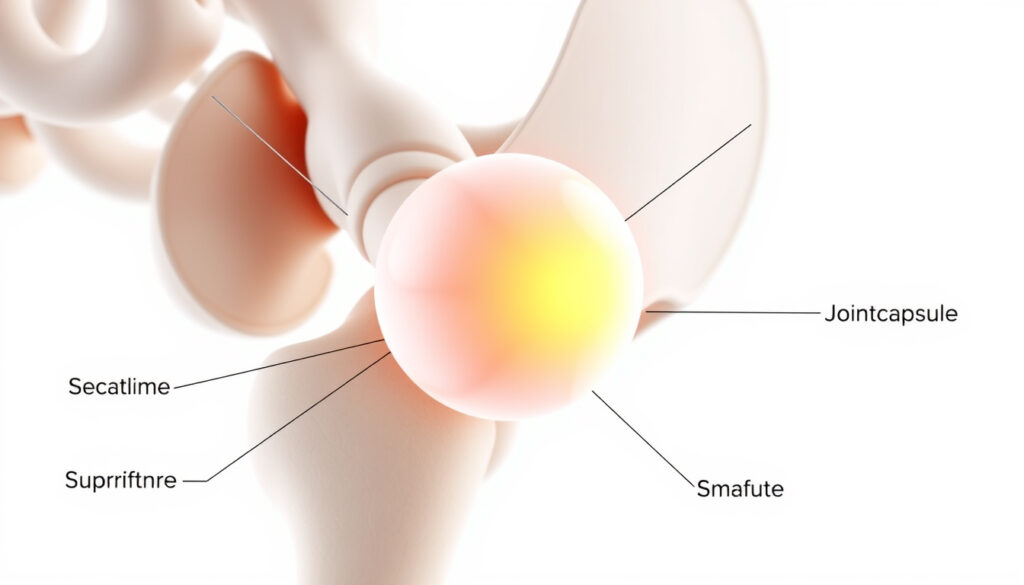
Ball and Socket Joint: Examples, Symptoms, Treatment
Anyone who has ever thrown a ball, climbed a flight of stairs, or simply raised a hand to wave has relied on the remarkable ball and socket joints in their shoulder and hip. These two joints allow the greatest range of motion of any synovial joint in the body, yet they are also among the most prone to injury and wear — a walk through the anatomy, common symptoms, causes of pain, and treatment options follows.
Ball and socket joints in human body: 2 · Primary examples: Shoulder and hip · Movement axes: Multi-axial (3 axes) · Common injury: Dislocation (shoulder)
Quick snapshot
- Only two ball and socket joints in humans: shoulder and hip (Lumen Learning (biology education platform))
- Allow multi-axial movement: flexion, extension, abduction, adduction, rotation, circumduction (Kenhub (medical education resource))
- Some sources incorrectly list additional joints (e.g., knuckles) as ball and socket; only shoulder and hip qualify (Joint Academy (evidence-based joint health platform))
- Anatomical classification of ball and socket joints has been standard since the 19th century (Wikipedia (open encyclopedia))
- Advances in joint replacement surgery continue to improve outcomes for damaged ball and socket joints (Hospital for Special Surgery (leading orthopedic hospital))
Four key facts show the basics of ball and socket joints at a glance.
| Label | Value |
|---|---|
| Number in Human Body | 2 |
| Types | Shoulder (glenohumeral), Hip (acetabulofemoral) |
| Movement | Multi-axial: flexion, extension, abduction, adduction, rotation, circumduction |
| Common Injury | Dislocation (shoulder), Osteoarthritis (hip) |
What joints are ball and socket?
What is the shoulder joint example?
- The shoulder joint, known as the glenohumeral joint, is a ball and socket joint where the head of the humerus fits into the glenoid fossa of the scapula (Kenhub (medical education resource)).
- It is the most mobile joint in the body, allowing a wide range of arm movements (Lumen Learning (biology education platform)).
What is the hip joint example?
- The hip joint, or acetabulofemoral joint, connects the head of the femur to the acetabulum of the pelvis (Kenhub (medical education resource)).
- It is more stable than the shoulder due to its deeper socket and strong ligaments, but still offers multi-axial movement (Joint Academy (evidence-based joint health platform)).
The shoulder’s exceptional mobility comes at a cost: it is the most commonly dislocated joint in the body, with an incidence of 23.9 per 100,000 person-years according to Wikipedia (open encyclopedia).
The implication: while both joints are ball and socket, the hip prioritizes stability, the shoulder prioritizes range — a design trade-off that directly influences injury patterns.
What are the 4 examples of ball and socket joints?
What are the four examples in the human body?
- Only two true ball and socket joints exist in the human body: the shoulder and the hip (Britannica (encyclopedia)).
- Some educational resources list four, but this is a misinterpretation; joints like the wrist (condyloid) and finger joints (hinge) do not have the spherical socket structure required (Joint Academy (evidence-based joint health platform)).
Are there any other ball and socket joints?
- No other synovial joints in the human body meet the anatomical definition of a ball and socket joint (Wikipedia (open encyclopedia)).
Misidentifying other joints as ball and socket can lead to confusion in diagnosis and treatment; a condyloid joint injury requires a different rehabilitation approach than a true ball and socket injury.
The pattern: the persistent “four examples” myth likely stems from oversimplified teaching materials, but authoritative anatomy sources consistently agree on shoulder and hip.
What are the symptoms of a ball and socket joint?
How is a ball and socket joint injury diagnosed?
- Diagnosis begins with a physical exam assessing pain, swelling, range of motion, and stability.
- Imaging is essential: X-rays for bone alignment, and high-resolution MRI to visualize soft tissues, cartilage, and labrum.
What are common signs of a damaged joint?
- Symptoms include pain, swelling, stiffness, reduced range of motion, and a catching or locking sensation.
- In the shoulder, pain may radiate down the arm; in the hip, it often localizes to the groin or outer thigh (Joint Academy (evidence-based joint health platform)).
The catch: symptoms overlap significantly between conditions, making accurate diagnosis reliant on both clinical judgment and imaging.
What causes pain in the ball and socket joint?
What are common injuries to ball and socket joints?
- Dislocation — the ball forced out of the socket — is most common in the shoulder, often from sports trauma (Bakul Arora Clinic (orthopedic practice)).
- Fractures around the joint, such as proximal humerus fractures or femoral neck fractures, cause acute pain and immobility.
What medical conditions affect ball and socket joints?
- Osteoarthritis: cartilage breakdown leads to bone-on-bone friction, pain, and stiffness, especially in the hip (Joint Academy (evidence-based joint health platform)).
- Rheumatoid arthritis: autoimmune inflammation damages the synovial lining, causing pain and swelling (Britannica (encyclopedia)).
- Tendinitis and bursitis: inflammation of tendons or bursae around the joint, often from overuse.
Persistent hip pain that does not respond to rest may indicate intra-articular pathology; delaying treatment can accelerate cartilage loss and limit surgical options later.
What this means: ball and socket joint pain is rarely a single-cause problem — a combination of mechanical, inflammatory, and degenerative factors often coexist.
How do you treat a ball and socket joint?
What non-surgical treatments are available?
- Initial management: rest, activity modification, physical therapy to restore range of motion and strength, and nonsteroidal anti-inflammatory drugs (NSAIDs) for pain.
- Corticosteroid injections can reduce inflammation and serve as a diagnostic tool to confirm the joint source of pain.
When is surgery needed for a ball and socket joint?
- Severe damage may require hip arthroscopy, osteotomy, fusion, or total hip replacement.
- For the shoulder, options include arthroscopic labral repair, rotator cuff repair, and shoulder replacement (Wikipedia (open encyclopedia)).
- The choice of surgery depends on the patient’s age, activity level, and the extent of joint damage.
For patients with hip arthritis, non-surgical measures can delay surgery by years; but once joint space is severely narrowed, replacement offers the best long-term pain relief and functional improvement.
The trade-off: conservative treatment preserves natural tissue but may not address advanced pathology, while surgery provides definitive relief but carries recovery time and implant longevity considerations.
Perspectives from anatomy and orthopedics
“Ball-and-socket joints allow the greatest range of motion among synovial joints.”
— Lumen Learning (biology education platform)
“High-resolution MRI is indispensable for visualizing bone and soft tissues in hip evaluation.”
— Hospital for Special Surgery (leading orthopedic hospital)
“The head of the femur fits into the acetabulum of the pelvis, forming the hip joint.”
— Kenhub (medical education resource)
For patients with chronic hip or shoulder pain, the clinical picture is clear: early intervention with physical therapy and anti-inflammatory medications can delay joint replacement, but severe cases may still require surgery. Best Pre-Workout Food Guide and Normal Cholesterol Levels NZ offer related health insights, though the focus here remains on joint anatomy and management.
anatomy.co.uk, study.com, youtube.com, youtube.com, simple.wikipedia.org, vedantu.com
For a deeper look at the structure and function of these joints, see our guide on ball and socket joint anatomy.
Frequently asked questions
What is the difference between a ball and socket joint and a hinge joint?
A ball and socket joint allows multi-axial movement (flexion, extension, abduction, adduction, rotation), while a hinge joint (like the elbow or knee) only permits flexion and extension along one axis.
Can you dislocate a ball and socket joint?
Yes — dislocation is common in the shoulder due to its shallow socket, and less common in the hip due to its deeper socket. Immediate medical attention is required to realign the joint.
How long does it take to recover from a ball and socket joint injury?
Recovery varies: minor strains may heal in 2–4 weeks, while dislocation or surgery can require 6–12 months of rehabilitation.
What exercises improve ball and socket joint mobility?
Range-of-motion exercises, such as arm circles, leg raises, and gentle stretching, help maintain mobility. Physical therapy often includes strengthening of surrounding muscles for stability.
What is the role of cartilage in ball and socket joints?
Articular cartilage covers the bone ends, providing a smooth, low-friction surface for movement and absorbing shock. Breakdown leads to osteoarthritis.
How do ball and socket joints differ from pivot joints?
Pivot joints allow rotation around a single axis (e.g., neck), while ball and socket joints allow rotation around multiple axes.
What are the surgical options for a damaged ball and socket joint?
Options include arthroscopy (minimally invasive repair), osteotomy (realignment), fusion (for severe cases), and total joint replacement (shoulder or hip arthroplasty).
More related posts
 New Zealand Holiday Insurance: Costs, Cover & Key Rules
 Free Things to Do in Auckland: 20+ No-Cost Activities & Tips
 Razer BlackShark V2 Pro 2023: Review, Specs & Comparisons
 Convert 2000 NZD to USD: Live Rate & Best Tips
 Dyson Wash G1 Review – Hard Floor Performance Pros Cons Tests
 Best Ad Blocker Chrome Extension: Guide for Desktop & Mobile
 How to Buy, Redeem & Troubleshoot Skinny Top Up Vouchers
 How to Reduce Blue Light Exposure: Proven Methods & Tips
