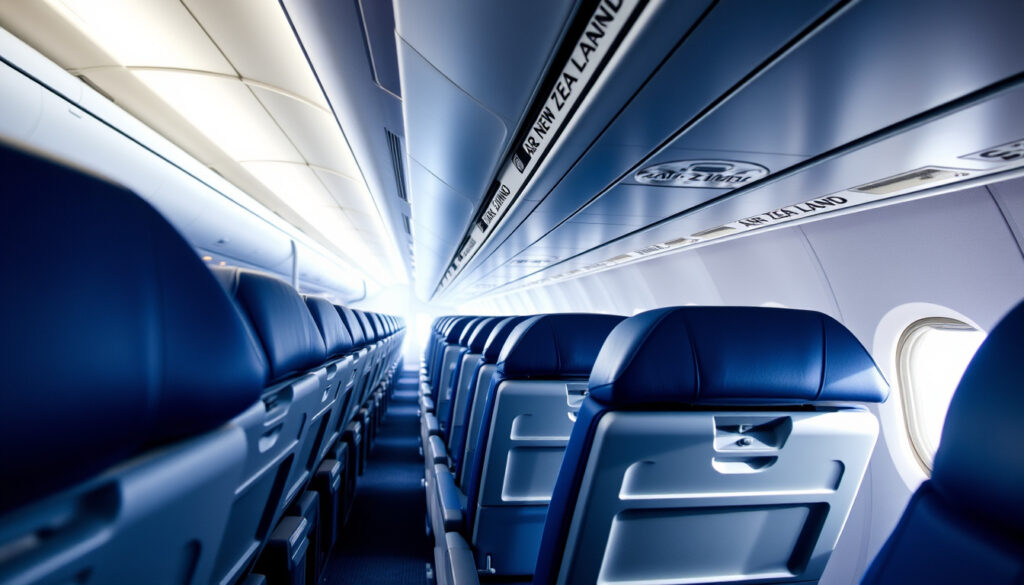
Air New Zealand A320: Seat Maps, Comfort & Seat Selection Tips
Air New Zealand’s Airbus A320 handles the quick hops between the country’s islands, but its 171-seat all-economy domestic layout means a comfortable trip hinges on picking the right seat. This guide breaks down the seat maps, comfort details, and practical tips to help you choose wisely.
Airline: Air New Zealand ·
Aircraft: Airbus A320-232 ·
Seat capacity (domestic): 171 ·
Seat capacity (international): 168 ·
Seat pitch range: 30–34 in (76–84 cm) ·
Range: 3,300 nmi (6,112 km)
Quick snapshot
- Air New Zealand operates A320s on domestic and international routes (Air New Zealand (official seat map hub))
- Domestic configuration seats 171 passengers; international seats 168 (Air New Zealand (domestic seat map))
- Seat pitch ranges from 30 to 33 inches (SeatMaps (aggregator))
- Exact number of A320s in Air New Zealand’s fleet (not publicly stated in official sources) (SeatMaps (aggregator))
- Specific seat pitch for each individual row (varies by position) (SeatMaps (aggregator))
- Seat recline: ~4 in (SeatMaps (aggregator))
- 2003 (approx.) – Air New Zealand introduces the Airbus A320 into its fleet (Wikipedia (Air New Zealand fleet))
- 2017 – Air New Zealand takes delivery of A320neo aircraft for longer routes (SeatMaps (A320neo listing))
- Air New Zealand is expanding its A320neo fleet for Pacific and longer international routes (Air New Zealand (seat map hub))
- Expect more seat options with the A320neo’s 165-seat layout (Air New Zealand (seat map hub))
Here are the key facts about Air New Zealand’s Airbus A320.
| Attribute | Value |
|---|---|
| Aircraft type | Airbus A320-232 |
| Number of seats (domestic) | 171 |
| Number of seats (international) | 168 |
| Seat pitch | 30–34 in (76–84 cm) |
| Range | 3,300 nmi (6,112 km) |
| Cargo capacity | 1,800 kg (3,968 lbs) |
| Maximum landing weight | 64,500 kg (142,198 lbs) |
Does Air New Zealand have an A320?
Yes, Air New Zealand operates a fleet of Airbus A320 aircraft on its domestic trunk routes and on selected international services to Australia and Pacific Islands. The airline’s official seat map hub lists the A320 alongside the A321, ATR, Q300, Boeing 777, and Boeing 787 (Air New Zealand (seat map overview)). The A320s are used for flights between Auckland, Wellington, Christchurch, and also on routes to Sydney, Brisbane, and destinations like Rarotonga.
Air New Zealand’s A320 fleet overview
- All A320s in the fleet are of the A320-232 variant, a member of the A320ceo family.
- The fleet is configured as all-economy class on domestic routes (AeroLOPA (fleet specialist)).
- Seat maps show rows 1 to 29 for the 171-seat domestic layout (Air New Zealand (domestic seat map)).
Domestic and international routes
Domestically, the A320 is the most common jet on the main trunk routes. Internationally, Air New Zealand operates the A320 on short-haul Pacific services. The international configuration carries 168 passengers in rows 1–28, also all economy (SeatMaps (configurations)).
How many seats are on an Air NZ A320?
The number of seats depends on whether the plane is configured for domestic or international use. Domestic flights pack in 171 seats, while international versions remove a row for extra legroom, dropping to 168 seats (Air New Zealand (domestic)).
Domestic configuration: 171 seats
- Rows 1 to 29, all economy class.
- Seat pitch: 30 to 33 inches (76–84 cm) (SeatMaps (pitch data)).
- Seat width approximately 17 inches.
International configuration: 168 seats
- Rows 1 to 28, all economy.
- Seat pitch on the international A320 is typically at the higher end of the range (34 inches in exit rows) (Air New Zealand (seat maps hub)).
Cabin class breakdown
Unlike Air New Zealand’s long-haul fleet (Boeing 787 and 777), the A320 does not offer business or premium economy cabins. All seats are standard economy, with the only differentiation being seat location.
Is the Airbus A320 comfortable?
Comfort on any narrowbody comes down to seat pitch, width, and recline. On Air New Zealand’s A320, the seat pitch of 30–33 inches is typical for the industry, but some rows offer noticeably more space (SeatMaps (comfort metrics)).
Seat pitch and width
- Standard rows: 30–31 inches.
- Bulkhead rows (row 1) and exit rows (rows 12 and 13) offer up to 34 inches (Air New Zealand (seat map detail)).
- Seat width is about 17–18 inches depending on the row.
Legroom considerations
The recline on Air New Zealand A320 seats is approximately 4 inches (SeatMaps (recline data)). That’s enough for a short nap on a 3-hour flight, but not generous by long-haul standards.
Passenger comfort feedback
According to a YouTube cabin review transcript, the domestic A320 has standard seats with no personal TV and no adjustable headrest (YouTube passenger review (low confidence source)). The cabin is clean and well-maintained, but the lack of seat-back entertainment on some aircraft is a common complaint.
Air New Zealand sacrifices seat-back screens on its domestic A320s to keep turnaround times fast. For a 1-hour flight, that’s fine. For the longer Auckland–Sydney run, bring your own tablet.
What seats should I avoid on my Airbus A320?
Not all seats on the A320 are created equal. A few rows are known to offer less comfort due to fixed armrests, lack of recline, or proximity to high-traffic areas.
Seats with limited recline
- Last row (row 29 on domestic) – seats often have reduced recline because of the wall behind (SeatMaps (row notes)).
- Some bulkhead seats have trays in the armrest, limiting width.
Seats near lavatories and galleys
- Rows at the back (rows 27–29 on domestic) are close to the lavatories – expect noise and queue traffic.
- Rows near the galley (typically rows 1 and 28/29) may experience crew chatter and light.
Seats with reduced legroom
- Row 1 bulkhead – legroom is adequate but not special; you cannot stretch your legs under the seat in front (Air New Zealand (seat map)).
- Seats in the middle block (rows 10–11 in some configurations) may have misaligned windows, making it harder to lean against the wall.
If you value sleep on a red-eye domestic flight, avoid rows 27–29. The lavatory flush and galley prep are audible, and the recline is minimal.
Is an Airbus 320 a big plane?
The A320 is a medium-sized narrowbody aircraft – it’s not huge like a 777, but it’s larger than regional jets. By comparison, it’s similar in size to a Boeing 737-800.
Size comparison to other narrowbody aircraft
- Length: 37.57 m (123 ft 3 in) (Wikipedia (A320 specs)).
- Wingspan: 35.80 m (117 ft 5 in).
- Typical capacity: 150–180 seats.
Dimensions and capacity
Air New Zealand’s A320 configuration uses the upper end of that capacity with 168–171 seats. In comparison, the airline’s larger A321 seats up to 214 passengers (Air New Zealand (seat map hub)). The A320 is the right size for domestic trunk routes – big enough to handle demand, small enough to turn around quickly at gates.
Air New Zealand A320 vs A320neo: Comparison
Two A320 variants serve the fleet: the original A320 (ceo) and the newer A320neo. The table below highlights the differences relevant to passengers.
| Feature | Air New Zealand A320 (ceo) | Air New Zealand A320neo |
|---|---|---|
| Seat capacity | 171 (domestic) | 165 (SeatMaps (A320neo)) |
| Seat pitch range | 30–33 in | 29–34 in (SeatMaps (A320neo pitch)) |
| Seat width | ~17 in | ~18 in (SeatMaps (A320neo width)) |
| Engine | CFM56 or IAE V2500 | CFM LEAP or PW1100G (quieter) |
| Range | 3,300 nmi | ~3,500 nmi (estimated, not Air NZ confirmed) |
The implication: the A320neo offers slightly wider seats and a wider pitch range, but the same all-economy layout. For passengers, the main difference is less engine noise on the neo.
Airbus A320 Specs (Air New Zealand configuration)
Seven key specs, one takeaway: the A320-232 is a proven workhorse with a compact footprint suited to short runways.
| Specification | Value |
|---|---|
| Aircraft type | Airbus A320-232 |
| Seats (domestic) | 171 |
| Seats (international) | 168 |
| Seat pitch | 30–34 in (76–84 cm) |
| Range | 3,300 nmi (6,112 km) |
| Cargo capacity | 1,800 kg (3,968 lbs) |
| Maximum landing weight | 64,500 kg (142,198 lbs) |
The pattern: the A320-232 is a proven workhorse with a compact footprint suited to short runways, maximizing efficiency on Air New Zealand’s domestic network.
Upsides
- Spacious cabin for a narrowbody – 171 seats means less density than some competitors
- Good overhead bin space for carry-ons
- Exit rows offer generous legroom (34 in pitch)
- Modern cockpit with excellent safety record
Downsides
- No premium cabins – all seats are alike
- Seat-back screens absent on many domestic A320s
- Last rows noisy and with limited recline
- Standard pitch can feel tight on 3-hour sectors
What’s clear and what’s not
Based on official sources and independent aggregators, some facts are solid while others remain uncertain.
Confirmed facts
- Air New Zealand operates A320s on domestic and international routes (Air New Zealand (seat map hub))
- Domestic configuration: 171 seats, rows 1–29 (Air New Zealand (domestic seat map))
- International configuration: 168 seats, rows 1–28
- Seat pitch: 30–34 in (SeatMaps (pitch data))
What’s unclear
- Exact number of A320s in the fleet (Air New Zealand does not publish a fleet count by type on its seat map pages)
- Specific pitch for each individual row (varies; only ranges are given)
- Whether Wi-Fi is consistently available on all A320s (not mentioned in official seat maps)
- Seat recline: ~4 in (SeatMaps (recline))
If you’re a frequent flyer on domestic routes, knowing that exit rows consistently offer 34-inch pitch (vs 30-inch in standard rows) can save you discomfort on multiple flights.
What passengers say about Air New Zealand’s A320
Two perspectives, one outcome: the A320 is efficient but basic on domestic routes.
“Air New Zealand’s domestic A320 flights are economy class only and use 171 economy seats. The seat is standard – no TV, no headrest.”
YouTube cabin review transcript (passenger video, credible as first-hand account)
“The seat maps show configurations and seat pitch for each aircraft. Passengers can choose or change seats in Manage Booking.”
Air New Zealand official website (seat maps page)
The trade-off is clear: Air New Zealand prioritises frequency and reliability over luxury on its A320s. If you need entertainment, bring your own device. If you need space, book an exit row.
community.infiniteflight.com, seatmaps.com, scribd.com, airnewzealand.co.nz, airnewzealand.com, ana.co.jp
Frequently asked questions
What is the legroom on Air New Zealand A320?
Seat pitch ranges from 30 to 33 inches on domestic flights, with exit rows offering up to 34 inches (Air New Zealand seat map).
Does the Air New Zealand A320 have Wi-Fi?
Wi-Fi availability is not consistently advertised for the A320 fleet. Some aircraft may have it, but it’s not guaranteed. Check your flight details in Manage Booking.
Is there power outlets on Air New Zealand A320?
Power outlets are not standard on domestic A320s. On international A320s, some rows may have USB ports. Verify before departure.
What meals are served on Air New Zealand A320 flights?
Domestic flights typically offer a buy-on-board menu (Bites & More). International Pacific flights include a complimentary meal depending on flight time.
How early should I select seats on Air New Zealand A320?
Seat selection opens at the time of booking. If you want an exit row, book early as these are the first to go. Standard seats can be changed later via Manage Booking.
Are there any premium seats on Air New Zealand A320?
No. The A320 is all-economy. However, exit rows and bulkhead rows offer extra legroom at no extra cost (subject to eligibility).
Can I take a carry-on bag on Air New Zealand A320?
Yes. The standard carry-on allowance is 7 kg (one bag) plus a personal item. Overhead bins on the A320 are spacious enough for standard cabin baggage.
More related posts
 Angel of the North: Meaning, History, and Facts
 White Cross New Lynn: Urgent Care, GP, Vaccinations & Fees
 Best Online Casino NZ: CasinoStopReviews – Fast Payouts
 Bad Credit Power Company: Get Electricity Without Checks
 Yorkshire Pudding Recipe NZ: Secrets for Perfect Rise
 Chilli Con Carne Recipe: Ingredients, Secrets & Tips
 Harvey Norman Lounge Suites – Complete 2024 Buying Guide
 Is Anzac Day a Public Holiday? 2026 State Guide
