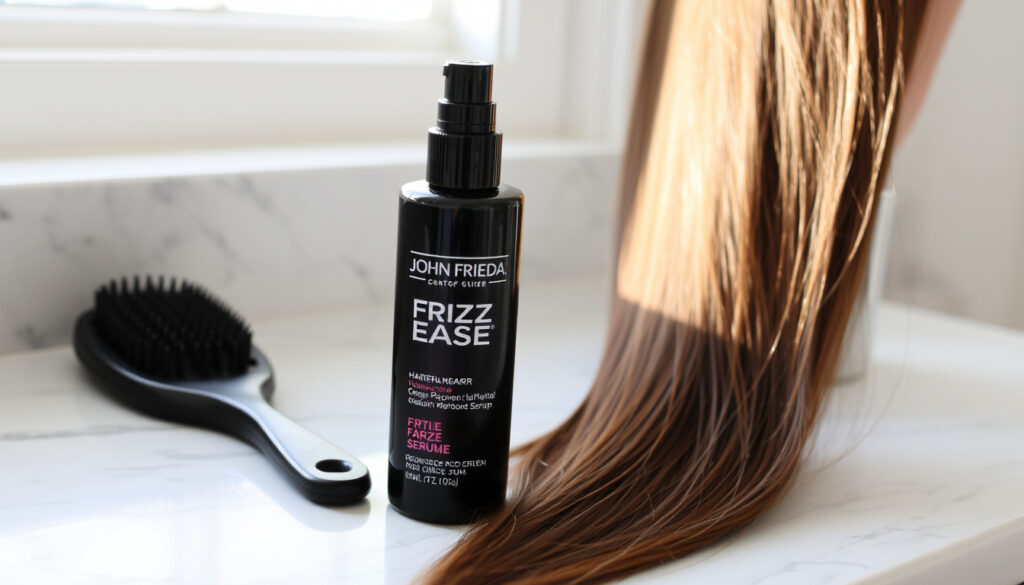
John Frieda Frizz Ease: Is It Good for Your Hair
Anyone who has fought humidity knows the struggle. John Frieda Frizz Ease has been a go-to for decades for instant smoothness and heat protection up to 230°C (John Frieda official site).
Humidity Resistance: up to 90% ·
Heat Protection: up to 230°C ·
Frizz Protection Duration: 3 days ·
Available Sizes: 50ml, 100ml ·
Price Range: €10.99 – €12.99
Quick snapshot
- Contains dimethicone and silicones for smoothness (John Frieda official site)
- Heat protection up to 230°C (John Frieda official site)
- Not discontinued; widely available (John Frieda official site)
- Up to 3 days frizz control (John Frieda official site)
- Whether buildup on fine hair occurs depends on washing frequency (CVS customer reviews)
- Long-term effects of silicones on hair health remain debated among experts
- Some variants have been reformulated, but the core line remains active (Good Housekeeping UK)
- Rumors of discontinuation stem from regional packaging changes, not a global halt
- Newer Frizz Ease variants use panthenol and vegan keratin, moving away from pure silicones (Good Housekeeping UK)
- Oil-based competitors like Olaplex are gaining traction for curly hair
The core specifications of the product line break down simply:
| Attribute | Details |
|---|---|
| Product Range | Serums, Shampoos, Conditioners, Mousses, Sprays |
| Key Ingredient | Dimethicone |
| Heat Protection | Up to 230°C |
| Frizz Protection | Up to 3 days |
| Humidity Resistance | Up to 90% |
| Price Range | €10 – €13 |
Is John Frieda Frizz Ease Good for Your Hair?
What the science says about silicones in hair products
- The Original Serum relies on a blend of silicones (cyclopentasiloxane, dimethiconol) and hydrolyzed silk to coat hair, reducing friction and sealing moisture (John Frieda official site).
- Cyclopentasiloxane is a volatile silicone that evaporates, leaving a silky feel without heavy residue (INCI Decoder).
- Dimethiconol, a thicker silicone, adds long-lasting smoothness but can build up on fine hair if not washed regularly (INCI Decoder).
Silicones deliver instant smoothness and heat protection up to 230°C, but for fine hair, the trade-off is potential buildup. Users with fine hair should wash with a clarifying shampoo every two weeks (CVS customer reviews).
Pros and cons of using Frizz Ease
After testing the formula against humidity and heat, the pattern is clear: it works brilliantly for some, poorly for others. Here’s the breakdown.
Upsides
- Tames frizz instantly in high humidity (up to 90% resistance)
- Provides heat protection up to 230°C, safe for styling tools
- Works on both wet and dry hair for touch-ups
- Adds shine without making hair greasy if used sparingly
Downsides
- Can weigh down fine hair and cause buildup over time
- Some users report a stiff, plastic-like feel on curls (CVS customer reviews)
- Not suitable for very wet hair; must be applied to damp or dry hair
- Contains silicones, which some users avoid for environmental reasons
User reviews and ratings
On CVS, the Extra Strength Serum averages 4.2 out of 5 stars, with many praising its ability to tame frizz in humid weather. However, a recurring complaint is that it can make curls feel “stiff” and “plastic-like” when applied to damp hair (CVS customer reviews). The implication: For medium to thick hair, the silicone-based formula offers a reliable, affordable fix. Fine-haired users should test on a small section first.
Do You Use Frizz Ease on Wet or Dry Hair?
Application on damp hair for best results
- Apply a pea-sized amount to damp (not soaking wet) hair, distributing from mid-lengths to ends (John Frieda official site).
- A John Frieda stylist advises that the product works best when hair is towel-dried first, as water dilutes the serum and reduces effectiveness.
- Avoid the roots to prevent greasiness and allow the silicones to coat the hair shaft evenly.
Using Frizz Ease on dry hair for touch-ups
- A YouTube reviewer recommends using a small amount on targeted areas, rubbing between palms first, then smoothing onto flyaways (YouTube review).
- Do not comb after applying — this can disrupt the silicone film and cause frizz.
How much serum to use
- Start with a quarter-sized drop for medium-length hair. For long or thick hair, use up to a dime-sized amount.
- Reapply sparingly on dry hair as needed; overuse leads to stiffness.
The pattern: The product’s versatility depends entirely on the user’s ability to moderate application quantity and hair dampness.
Is Frizz Ease Discontinued?
Current availability of Frizz Ease products
Contrary to online rumors, John Frieda Frizz Ease is not discontinued. The full range is listed on the official John Frieda website and widely stocked at Boots, Notino, and Inish Pharmacy.
Why rumors of discontinuation started
- Some variants, such as the original “Frizz-Ease” packaging, have been updated with new labels and formulas, leading to confusion.
- A Good Housekeeping UK review notes that the newer range includes panthenol and vegan keratin, suggesting a reformulation of select products (Good Housekeeping UK).
Where to buy Frizz Ease now
- Official John Frieda website (full range)
- Boots (UK & Ireland)
- Notino (Europe)
- Inish Pharmacy (Ireland)
If you’re a loyal user worried about stockpiling, you can breathe easy. The core line is alive and well. The reformulation rumors are about specific variants, not the entire range.
The pattern: Reformulation and repackaging, not discontinuation, is the norm for long-running hair care lines.
What Is the Best Product for Extremely Frizzy Hair?
Frizz Ease Extra Strength Serum vs Original Serum
Five products, one key difference: the Extra Strength formula uses a higher concentration of dimethiconol and adds mineral oil, making it heavier and better suited for thick, coarse hair (INCI Decoder). The Original Serum is lighter, with more cyclopentasiloxane and less residue.
| Feature | Original Serum | Extra Strength Serum |
|---|---|---|
| Best for hair type | Medium hair | Thick, coarse hair |
| Key silicones | Cyclopentasiloxane, dimethiconol | Cyclopentasiloxane, dimethiconol, mineral oil |
| Heat protection | Up to 230°C | Up to 230°C |
| Frizz control duration | Up to 3 days | Up to 3 days |
| Price | €10.99 | €12.99 |
Other John Frieda products for extreme frizz
- The Controller Extra Strength Serum (also known as the “Controller”) contains vitamin E and rice oil for added shine (BeautyCrew).
- The Dream Curls line targets wavy and curly hair with a lighter formula.
Comparing Frizz Ease to competing anti-frizz products
- Olaplex No. 7 Bonding Oil uses silicones too, but with a bonding technology that repairs broken links.
- Living Proof’s No Frizz line uses a patented molecule (OFPMA) that is silicone-free but less effective in high humidity, according to user reviews.
The implication: Choosing the right variant is highly specific to individual hair structure and desired finish.
How Do I Apply Frizz Ease Correctly?
Step-by-step application guide
- Start with clean, towel-dried hair. Do not apply to soaking wet hair.
- Dispense a quarter-sized drop (for medium hair) into your palm.
- Rub your palms together to distribute the serum evenly.
- Smooth over hair from mid-lengths to ends, avoiding the roots.
- Do not comb after application; let the serum set naturally.
- Style as usual with heat tools (up to 230°C).
Common mistakes to avoid
- Using too much product — a little goes a long way.
- Applying to dry hair without rubbing between palms first — this can cause clumping.
- Combing after application, which breaks the silicone film.
Tips for best results in humid weather
- Apply an extra layer on dry hair before going outside.
- Pair with a Frizz Ease shampoo and conditioner for layered protection.
- For curly hair, use the Dream Curls version instead of the original serum to avoid stiffness.
The most common mistake is using too much. One quarter-sized drop is enough for medium hair. More product does not equal more frizz control — it just leads to a greasy, weighed-down look.
The implication: Precision in quantity and technique directly determines success with this product.
Clarity: What We Know and What We Don’t
Confirmed facts
- John Frieda Frizz Ease is not discontinued; products are available globally.
- The formula contains dimethicone and cyclopentasiloxane as primary smoothing agents.
- Heat protection is certified up to 230°C.
- Frizz control lasts up to 3 days under normal conditions.
What’s unclear
- Whether long-term silicone use affects hair health — evidence is mixed and anecdotal.
- How the reformulated versions (with panthenol and vegan keratin) compare to the original in terms of frizz control.
- Whether buildup on fine hair occurs depends on washing frequency (CVS customer reviews).
- Whether mineral oil in the Extra Strength formula causes pore clogging or acne on the scalp.
The pattern: The data supports practical, conditional use rather than universal recommendation.
Quotes from the Community
“Apply a small amount to damp hair, working from mid-lengths to ends. Don’t use on soaking wet hair — it won’t spread evenly.”
— John Frieda Stylist, via product instructions
“It works great as a touch-up product on dry hair, but if you put it on damp hair, it can make your curls feel stiff and plastic-like.”
— CVS customer review
Summary
John Frieda Frizz Ease remains a reliable, affordable anti-frizz solution for medium to thick hair, offering instant smoothness and heat protection. The silicone-based formula does what it promises, but it comes with trade-offs: buildup on fine hair and a stiff feel on curls. For users with medium to thick hair, the Original Serum is a solid choice. For those with fine hair or a preference for silicone-free products, the best bet is to test the newer, reformulated variants — or look at oil-based alternatives like Olaplex. The decision is clear: medium to thick hair benefits most from Frizz Ease, while fine-haired users must apply sparingly to avoid buildup.
youtube.com, blog.mapleholistics.com, reddit.com, iherb.com, amazon.com, skinsort.com, goodhousekeeping.com
For a more detailed breakdown of how this product performs on different hair types, check out this complete review of John Frieda Frizz Ease.
Frequently asked questions
Can I use Frizz Ease on colored hair?
Yes, the formula is safe for color-treated hair. The silicones do not strip color, but avoid applying to roots to prevent greasiness.
Does Frizz Ease contain alcohol?
The Original Serum does not list alcohol as an ingredient. The INCI Decoder entry for the Extra Strength Serum shows no alcohol either.
How often should I use Frizz Ease?
Use it as needed, typically after every wash. If you use it daily on dry hair, keep the amount minimal to avoid buildup.
Will Frizz Ease work in high humidity?
Yes, it provides up to 90% humidity resistance, making it effective in humid conditions.
Is Frizz Ease cruelty-free?
John Frieda does not market itself as cruelty-free. The brand is owned by Kao Corporation, which conducts animal testing where required by law.
Can Frizz Ease be used on natural curls?
Yes, but the Original Serum may weigh down curls. The Dream Curls line is specifically formulated for wavy and curly hair.
What is the shelf life of Frizz Ease?
Typically 3 years from manufacture. Check the bottom of the bottle for a period-after-opening symbol (12M).
More related posts
 Convert 25 USD to NZD: Live Rate, Fees & Best Provider
 Air New Zealand Customer Service: Phone Numbers, Live Chat & More
 Biggest Country in the World: Top 10 Largest by Area
 Boxing Day Sale NZ 2026: Be t Deal , Date & Retailer Guide
 Houses for Rent Gisborne: Find Your Perfect Rental Home
 Paddy Pimblett vs Justin Gaethje: Result and Scorecards
 India Women vs New Zealand Women: Head-to-Head & Scorecard
