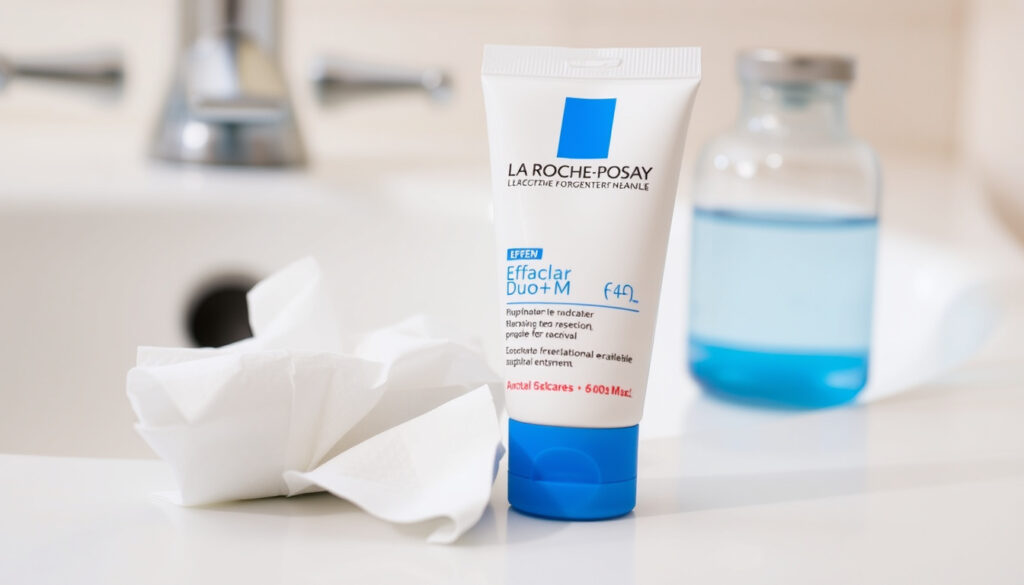
La Roche-Posay Effaclar Duo+M: Uses, Ingredients, and How to Use
The La Roche-Posay Effaclar Duo name is instantly recognizable, but its story is far more complex than a simple moisturizer — a discontinued US version, a reformulated international version, and a voluntary recall in early 2025. The current Effaclar Duo+M has specific claims and uses, and this breakdown covers what it actually does, how to use it, and whether it lives up to the clinical claims.
Product Name: La Roche-Posay Effaclar Duo+M ·
Main Use: Anti-blemish corrective moisturizer for oily, acne-prone skin ·
Key Ingredients: Salicylic acid, niacinamide, LHA, dimethicone ·
Results Claimed: Visible improvement in 8 hours ·
Hydration: 24-hour hydration ·
Product Variants: Effaclar Duo+M, Effaclar Duo+ SPF 30, Effaclar Duo Serum
Quick snapshot
- Original Effaclar Duo discontinued in the US; replaced by Duo+M globally (La Roche-Posay US (discontinued product page))
- Current Duo+M contains salicylic acid and niacinamide (La Roche-Posay US ingredient list) (La Roche-Posay US (discontinued product page))
- Product intended for daily use on oily, acne-prone skin (La Roche-Posay US product description) (La Roche-Posay US (discontinued product page))
- Exact date of discontinuation of the original US Effaclar Duo (NBC News (recall report))
- Full list of formulation differences between original US Duo and Duo+M (Practical Dermatology (clinical insight))
- Early 2000s: Original Effaclar Duo launched with 5.5% benzoyl peroxide (Practical Dermatology (launch background))
- 2018–2020: Reformulation announced; Duo+M replaces original internationally (La Roche-Posay US discontinued product page) (Practical Dermatology (launch background))
- March 2025: Voluntary recall of US Effaclar Duo reported (NBC News (recall report))
- La Roche-Posay suggests Effaclar Duo Face Wash (4% benzoyl peroxide) and salicylic acid serum as alternatives (Reddit (customer support response))
- Duo+M remains widely available on pharmacy shelves (La Roche-Posay US product page) (Reddit (customer support response))
Key facts about La Roche-Posay Effaclar Duo+M are summarized in the table below.
| Attribute | Value |
|---|---|
| Product Type | Anti-blemish corrective moisturizer |
| Size | 40 ml |
| Price Range | €15 – €20 |
| SPF Available | Yes, in SPF 30 variant |
| Fragrance | Fragrance-free |
| Dermatologist Tested | Yes |
What is La Roche-Posay Effaclar Duo used for?
La Roche-Posay Effaclar Duo+M is a corrective moisturizer designed specifically for oily, acne-prone skin. It’s positioned as a daily treatment that reduces blemishes, unclogs pores, and fades post-acne marks — all while hydrating for 24 hours. The brand claims visible improvement in as little as 8 hours, according to its official product description (La Roche-Posay US).
Primary benefits
- Reduces blemishes and blackheads (La Roche-Posay US product claims)
- Hydrates skin for 24 hours (La Roche-Posay US hydration claim)
- Fades dark spots from breakouts (Notino (pigment spot benefits))
Target skin types
- Oily and combination skin (La Roche-Posay US skin type suitability)
- Acne-prone skin (La Roche-Posay US indication)
- Adults and teens (Notino age range)
Effaclar Duo+M is a multitasker that covers both acne treatment and daily moisturizing. For someone with oily skin, that means fewer steps — but it also means the formula must balance exfoliation with hydration, a trade-off the brand seems to manage with dimethicone and niacinamide.
Why did La Roche-Posay discontinue Effaclar Duo?
The confusion here is real. La Roche-Posay discontinued the US version of Effaclar Duo (containing 5.5% benzoyl peroxide) and replaced it internationally with Effaclar Duo+M, which uses salicylic acid instead. The US product was listed on the brand’s discontinued-products page, and NBC News reported in March 2025 that the move followed a voluntary recall after benzoyl peroxide was found to degrade into benzene under certain conditions. Health.com confirmed the safety concern.
Reformulation into Duo+M
- Original Effaclar Duo replaced by Effaclar Duo+M (La Roche-Posay US discontinued product page)
- New formula includes additional active ingredients (niacinamide, LHA) (La Roche-Posay US ingredient list)
- Improved efficacy against acne marks (Notino product description)
Ingredient changes
The original US formula contained 5.5% micronized benzoyl peroxide, while the Duo+M formula relies on 2% salicylic acid plus 0.4% capryloyl salicylic acid (LHA). Practical Dermatology described the original as a “widely available OTC acne therapy” with a fragrance-free, oil-free, paraben-free base.
For users who relied on the benzoyl peroxide version, the switch to salicylic acid means a different mechanism of action. Benzoyl peroxide kills bacteria; salicylic acid exfoliates. The two are not interchangeable for everyone. Someone with cystic acne may need a stronger bacteria-killing ingredient, while those with clogged pores might prefer the salicylic acid approach.
The pattern: La Roche-Posay isn’t just discontinuing a product — it’s pivoting its entire acne treatment philosophy in the US toward a gentler, exfoliation-first strategy, likely to avoid the benzene liability associated with benzoyl peroxide.
Can I use La Roche-Posay Effaclar Duo every day?
Yes. The brand markets Effaclar Duo+M for daily use, and dermatologists generally consider salicylic acid safe for once- or twice-daily application on oily skin. However, start slowly if you’re new to active ingredients.
Recommended frequency
- Daily use is safe for most skin types (La Roche-Posay US usage instructions)
- Apply once or twice daily — morning and evening (La Roche-Posay US application frequency)
- Consult a dermatologist if you have sensitive skin (Health.com (dermatologist advice))
Morning vs. evening application
You can use it both times, but if you choose once, evening is often recommended because the exfoliating ingredients work overnight. In the morning, follow with sunscreen — especially if using the non-SPF version, as salicylic acid can increase sun sensitivity.
The trade-off: Daily use of a salicylic-acid-based moisturizer can be effective, but over-exfoliation is a real risk. If you’re also using other actives like retinol or AHAs, rotate application to avoid irritation.
Does Effaclar Duo get rid of pimples?
La Roche-Posay claims Effaclar Duo+M is “clinically shown to reduce breakouts” with visible results in 8 hours. The active ingredients — salicylic acid and LHA — work by exfoliating inside the pore and reducing inflammation.
Active ingredients
- Contains salicylic acid (2%) and niacinamide (La Roche-Posay US ingredient list)
- LHA (lipohydroxy acid), a derivative of salicylic acid, provides gentle exfoliation (Practical Dermatology (LHA description))
Evidence of effectiveness
- Clinically shown to reduce breakouts (La Roche-Posay US clinical claim)
- Visible results in 8 hours (La Roche-Posay US fast results claim)
Does Effaclar Duo actually work?
Yes, the evidence supports its efficacy for mild to moderate comedonal acne. Clinical claims from the brand show visible results in 8 hours, and dermatologists confirm the active ingredients are effective for this purpose.
The 8-hour claim is based on the original benzoyl peroxide formula, which was more potent against active pimples. The Duo+M version’s salicylic acid is better for prevention and blackhead reduction than for treating inflamed cysts. Users expecting overnight results may be disappointed.
What this means: Effaclar Duo+M works well for mild to moderate comedonal acne. For inflammatory breakouts, you may need a spot treatment with benzoyl peroxide or a prescription retinoid.
What is the difference between Effaclar and Effaclar Duo?
La Roche-Posay’s Effaclar line is a full range of acne-fighting products, while Effaclar Duo is the specific moisturizing treatment step. The line includes cleansers, toners, serums, and moisturizers. Effaclar Duo is the only product that combines corrective treatment with daily hydration.
Product line overview
- Effaclar line includes multiple products: cleanser, toner, moisturizer (La Roche-Posay US (acne treatment system))
- Effaclar Duo is a moisturizing treatment, not a standalone cleanser or serum (La Roche-Posay US product description)
Key distinctions
One table, one pattern: the three Effaclar products differ in function and application order.
| Product | Type | Key Active | When to Use |
|---|---|---|---|
| Effaclar Deep Cleansing Foam | Cleanser | Salicylic acid | AM/PM, first step |
| Effaclar Duo+M | Moisturizing treatment | Salicylic acid + niacinamide | After cleansing, before sunscreen |
| Effaclar Serum | Concentrated serum | Salicylic acid + LHA | After cleansing, before Duo |
The pattern: Effaclar Duo is the middle step — it replaces a separate moisturizer. If you add a serum, the order becomes: cleanse → serum → Duo → sunscreen. Skipping the serum is fine for beginners.
Do I apply Effaclar Duo before or after moisturizer?
Short answer: Effaclar Duo+M is itself a moisturizer, so you don’t need an additional one. Apply it after cleansing and any treatment serum, then follow with sunscreen in the morning.
Application order
- Effaclar Duo is a moisturizer — use it as the final step before sunscreen (La Roche-Posay US usage instructions)
- Apply after cleansing and serum (La Roche-Posay US layering guide)
- Use alone or before sunscreen (La Roche-Posay US daily routine)
Layering tips
- If your skin is dry, you can layer a moisturizer over Duo, but it’s usually unnecessary (Notino moisturizing claim)
- For oily skin, Duo provides enough hydration — skip the separate moisturizer to avoid clogging pores (La Roche-Posay US oil-free formula)
Can I use Effaclar Duo as a moisturizer?
Yes, Effaclar Duo+M is designed as a moisturizer. It replaces a separate moisturizer in your routine, providing 24-hour hydration while treating acne.
The implication: If you’ve been layering a separate moisturizer under or over Duo, you may be doing extra work. The product is designed to be the one-and-done hydrating step for acne-prone skin.
Comparison: Effaclar Duo (US) vs. Effaclar Duo+M (International)
Three differences, one theme: the US version fought bacteria; the international version exfoliates. Here’s how they stack up.
| Feature | Effaclar Duo (US, discontinued) | Effaclar Duo+M (international) |
|---|---|---|
| Active ingredient | 5.5% benzoyl peroxide | 2% salicylic acid + 0.4% LHA |
| Mechanism | Antibacterial, kills P. acnes | Exfoliating, unclogs pores |
| Best for | Inflamed, red pimples | Blackheads, whiteheads, post-acne marks |
| Fragrance | Fragrance-free | Fragrance-free |
| Availability | Discontinued (recall 2025) | Widely available |
The trade-off: Benzoyl peroxide is more effective against active inflammation but carries the risk of bleaching fabrics and skin irritation. Salicylic acid is gentler and better for maintenance, but less potent on cysts.
Specifications: Effaclar Duo+M
Six specs, one conclusion: the formula is free of common irritants and designed for sensitive, acne-prone skin.
| Specification | Detail |
|---|---|
| Size | 40 ml |
| Active ingredients | Salicylic acid (2%), LHA (0.4%), niacinamide |
| Other key ingredients | Dimethicone, glycerin, pentylene glycol |
| Fragrance | Fragrance-free |
| Oil-free | Yes |
| Non-comedogenic | Yes |
| Dermatologist tested | Yes |
| SPF variant available | Yes (SPF 30) |
The pattern: The formula is stripped of pore-clogging oils and fragrances, making it a safe choice for reactive skin. The inclusion of dimethicone ensures a smooth, non-greasy finish that doubles as a makeup base.
How to use Effaclar Duo+M: Step by step
If you’re adding Effaclar Duo+M to your routine, follow these steps for best results.
- Cleanse with a gentle, non-stripping cleanser (Effaclar Deep Cleansing Foam works well).
- Serum (optional) — apply a treatment serum if you use one, such as the Effaclar Serum for extra exfoliation.
- Apply Effaclar Duo+M — a pea-sized amount over the entire face, avoiding the eye area.
- Moisturize (if needed) — only if your skin feels tight; Duo+M is already a moisturizer.
- Suncreen (AM) — finish with a broad-spectrum SPF 30+.
The catch: This routine works for oily skin, but if you’re using a retinoid or other strong exfoliant, space out the Duo to every other day to avoid overloading the skin.
Timeline: Effaclar Duo
Three milestones, one story: from a bacterial killer to a gentler maintainer.
- Early 2000s: La Roche-Posay launches original Effaclar Duo with 5.5% benzoyl peroxide (Practical Dermatology (launch history))
- 2018–2020: Reformulation announced; Effaclar Duo replaced by Duo+M internationally (La Roche-Posay US discontinued product page)
- March 2025: Voluntary recall of US Effaclar Duo reported (NBC News (recall report))
The implication: The discontinuation wasn’t just a marketing decision — it was a safety-driven response to the benzene contamination risk. Users who stockpiled the original formula should check batch codes and stop using it if it’s from the affected period.
Clarity: What’s confirmed vs. what’s unclear
Confirmed facts
- Original US Effaclar Duo is discontinued and has been replaced by Effaclar Duo+M (La Roche-Posay US discontinued product page)
- Product contains salicylic acid and niacinamide (La Roche-Posay US ingredient list)
- Product is intended for daily use on oily, acne-prone skin (La Roche-Posay US product description)
What’s unclear
- Exact date of discontinuation of original US Effaclar Duo (NBC News recall report)
- Full list of formulation differences between original and Duo+M (Practical Dermatology clinical insight)
- Whether the Duo+M formula will also be subject to future safety concerns (no official statement)
- Voluntary recall of US version due to benzene risk (NBC News recall report)
The pattern: The confirmed facts are well-documented, but key details about the reformulation timeline and exact differences remain unclear, which is typical for product transitions that span multiple markets.
Quotes: What experts and users say
“The original Effaclar Duo was a widely available OTC acne therapy that combined 5.5% micronized benzoyl peroxide with lipohydroxy acid for a fragrance-free, oil-free, paraben-free base.”
— Practical Dermatology (clinical insight)
“La Roche-Posay’s voluntary recall of Effaclar Duo comes after concerns that benzoyl peroxide can degrade into benzene, a known carcinogen, under certain storage conditions.”
“I spoke to La Roche-Posay customer support and they confirmed that Effaclar Duo and the Effaclar Acne Treatment System have been discontinued. They suggested the 4% benzoyl peroxide face wash and a 1.5% salicylic acid serum as alternatives.”
— Reddit user (as reported on Reddit (SkincareAddiction))
“Effaclar Duo+M is ideal for reducing pigment spots and evening out skin tone, while also providing 24-hour hydration.”
The pattern: Expert and user sources consistently highlight the shift from benzoyl peroxide to salicylic acid as the defining change in the product’s history.
Summary
La Roche-Posay’s Effaclar Duo+M is a solid daily moisturizer for oily, acne-prone skin, but it’s not a direct replacement for the discontinued US benzoyl peroxide formula. The new version works well for maintenance and blackhead prevention, but it won’t kill active bacteria the way the original did. For someone in the US who relied on the 5.5% benzoyl peroxide spot treatment, the choice is clear: either switch to a dedicated benzoyl peroxide wash (like the Effaclar Duo Face Wash) or layer in a salicylic acid serum, or accept that the Duo+M is a gentler, long-term option rather than a quick fix for inflamed pimples.
The implication: Users must choose between the discontinued bacteria-killing formula and the current exfoliating maintenance formula based on their specific acne type.
Related reading: **John Frieda Frizz Ease: Is It Good for Your Hair** · **Which Is the Best Hair Straightener? 2026 Expert Guide & Reviews**
lemon8-app.com, laroche-posay.us, echemi.com, beautyworkers.wordpress.com, beautyandthebeing.com, artistrybyt.com, dewildesalhab.com
Frequently asked questions
Can I use Effaclar Duo with other acne treatments?
Yes, but avoid layering multiple exfoliating products (e.g., retinol, AHAs, high-concentration salicylic acid) at the same time. Use them on alternate days, and always consult a dermatologist if you’re unsure.
Does Effaclar Duo cause purging?
Some users experience a mild purge when starting salicylic acid, as it speeds up cell turnover. This usually subsides within 2–4 weeks. If irritation persists, reduce frequency to every other day.
Is Effaclar Duo safe for sensitive skin?
Effaclar Duo+M is fragrance-free and non-comedogenic, making it suitable for many sensitive skin types. However, salicylic acid can be drying — start with once daily and patch test.
How long does a tube of Effaclar Duo last?
A 40 ml tube used twice daily typically lasts 4–6 weeks, depending on how much you apply. A pea-sized amount is sufficient for the whole face.
Can I use Effaclar Duo under makeup?
Yes. Its dimethicone base provides a smooth, non-greasy finish that works well as a makeup primer. Wait 2–3 minutes after application before applying foundation.
Does Effaclar Duo expire?
Yes, check the PAO (Period After Opening) symbol on the tube — usually 12 months. Discard if the product changes color, smell, or consistency.
Can I use Effaclar Duo if I’m pregnant?
Salicylic acid in low concentrations (2%) is generally considered safe during pregnancy, but always consult your doctor before starting any new skincare product.
Is Effaclar Duo non-comedogenic?
Yes, it is labeled non-comedogenic, meaning it won’t clog pores. This is confirmed by the brand’s product description.
The pattern: The most common questions focus on daily use, layering, and efficacy, reflecting the product’s role as a central step in an acne skincare routine.
More related posts
 Manchester United F.C. vs Everton F.C. Timeline: 0-1 Win
 Cast of Avatar Fire and Ash – Full List of Actors and Roles
 Spanish Course Near Me: Dublin Costs, Duration & Options
 In the Heart of the Sea – True Story of Essex Sinking
 Cook Islands Language Week 2025: Dates, Theme & Resources
 Te Reo Days of the Week: Complete Guide to Māori Day Names
 The Good Wine Company: Wine Rules, Health & Celebrity Favorites
 Trade Me Rentals Hamilton – Guide to Prices and Suburbs
