In the Heart of the Sea – True Story of Essex Sinking
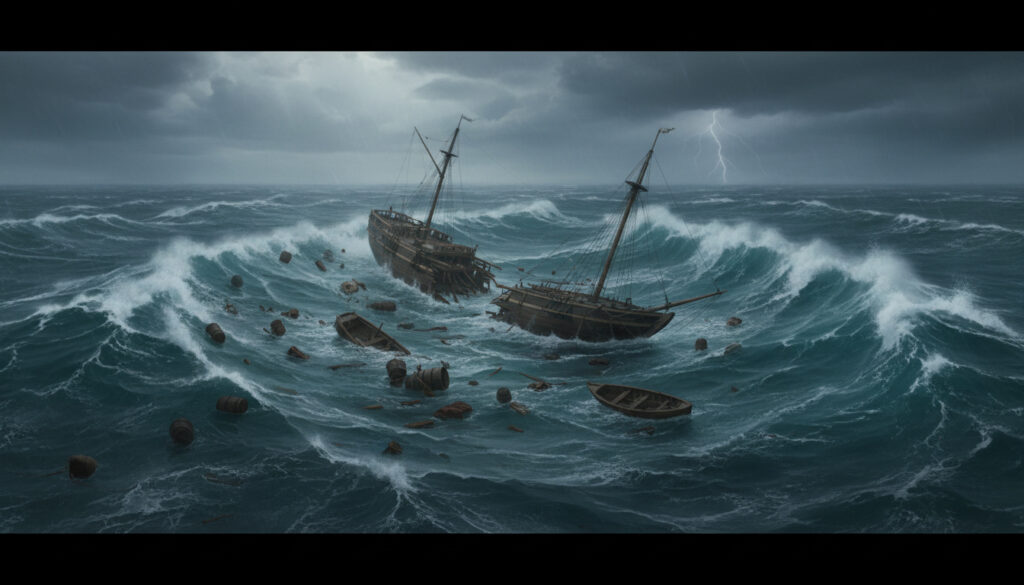
On November 20, 1820, a sperm whale estimated at 85 feet long rammed the whaleship Essex twice with deliberate force, crushing its timbers and sending the vessel to the bottom of the South Pacific within ten minutes. The sinking stranded twenty crew members approximately 2,000 nautical miles from the South American coast, forcing them into a harrowing ninety-three-day ordeal of starvation, dehydration, and desperate choices that would become one of maritime history’s most infamous disasters.
Two centuries later, the tragedy remains seared into American literary and cultural memory. The disaster directly inspired Herman Melville’s Moby-Dick and provided the basis for Nathaniel Philbrick’s 2000 National Book Award-winning narrative, which Ron Howard adapted into a 2015 film starring Chris Hemsworth. The story continues to raise unsettling questions about human endurance, the ethics of survival, and the mysteries of cetacean behavior. Wikipedia provides detailed production records for the adaptation.
What Is In the Heart of the Sea About?
Directed by Ron Howard, starring Chris Hemsworth as First Mate Owen Chase.
Adapts the 1820 sinking of the whaleship Essex and its crew’s survival ordeal.
The historical event directly inspired Herman Melville’s Moby-Dick (1851).
Brendan Gleeson portrays an aging Thomas Nickerson recounting the voyage to Melville.
- The Essex was a Nantucket-based whaler launched in 1799.
- Twenty men departed on August 12, 1819; eight returned alive in June 1821.
- The sperm whale attack occurred off the coast of Ecuador on November 20, 1820.
- Survivors drifted for up to ninety-three days, resorting to cannibalism.
- The film is based on Nathaniel Philbrick’s 2000 nonfiction account.
- Principal photography utilized water tanks at Warner Bros. Studios Leavesden and Canary Islands locations.
- The movie compresses the timeline but retains the documented sequence of deaths and rescues.
| Fact | Movie Depiction | Historical Record |
|---|---|---|
| Whale Attack | Dramatized CGI sequences | Confirmed by multiple eyewitness accounts |
| Crew Size | Approximately twenty men | Twenty men (one deserted in Peru) |
| Sinking Date | November 1820 | November 20, 1820 |
| Location | South Pacific | 2,000 nautical miles west of South America |
| Survival Duration | Compressed narrative | 89–93 days depending on the boat |
| Cannibalism | Depicted on screen | Documented in Chase and Nickerson journals |
| Rescue Dates | February 1821 | February 18 and 23, 1821 |
Plot Summary
The film frames the narrative through the eyes of an aging Thomas Nickerson, recounting the voyage to a young Herman Melville. The story flashes back to 1819, when the Essex departed Nantucket under inexperienced Captain George Pollard Jr., with First Mate Owen Chase serving as the de facto leader. After a series of mishaps including a squall-damaged sail and an accidental fire in the Galápagos, the vessel encounters a massive sperm whale that repeatedly strikes the bow, sinking the ship and forcing the crew into three small whaleboats with severely limited provisions.
Key Events from the Essex Sinking
The crew salvaged bread, water, charts, and a spare whaleboat before dividing into three groups led by Pollard, Chase, and Second Mate Matthew Joy. They drifted westward for approximately one month before landing on Henderson Island, where three men chose to remain behind. The remaining seventeen continued toward South America, but starvation and dehydration claimed lives quickly. The survivors resorted to cannibalism to sustain themselves through the eighty-nine to ninety-three-day ordeal, with rescue vessels finally spotting the emaciated men in February 1821. History.com archives the complete drift trajectory and rescue coordinates.
Is In the Heart of the Sea Based on a True Story?
The Real Whaleship Essex
The Essex was a Nantucket-based American whaleship launched in 1799, built of white oak and measuring 87 feet in length. On August 12, 1819, the vessel departed under Captain George Pollard Jr. for a whaling voyage expected to last two to three years. After rounding Cape Horn, the ship spent months in the South Pacific whaling grounds, accumulating oil before the catastrophic encounter. Encyclopaedia Britannica confirms the vessel’s specifications and departure details, while Wikipedia documents the crew composition and navigation logs.
Nathaniel Philbrick’s Book
Historian Nathaniel Philbrick published In the Heart of the Sea: The Tragedy of the Whaleship Essex in 2000, synthesizing primary sources including Owen Chase’s 1821 narrative and Thomas Nickerson’s recently rediscovered journal. The work examines Nantucket’s Quaker whaling culture, the environmental pressures of depleted fishing grounds, and the psychological dimensions of the survivors’ choices. The book won the National Book Award for Nonfiction and established the definitive modern account of the disaster. Philbrick’s official site and IMDb confirm the adaptation details.
Survivor accounts from Owen Chase and cabin boy Thomas Nickerson provide corroborating evidence for the whale attack timeline and cannibalism details, though minor discrepancies exist regarding exact crew counts and the sequence of deaths.
How Does In the Heart of the Sea Relate to Moby-Dick?
Herman Melville’s Inspiration
Herman Melville drew directly from the Essex disaster while composing Moby-Dick (1851), particularly for the climactic sequence in which the white whale destroys the Pequod. The author obtained a copy of Chase’s narrative and interviewed Captain Pollard during a visit to Nantucket, incorporating the sense of implacable nature and maritime doom into his metaphysical novel. The true story behind Moby-Dick connects these historical threads, demonstrating how a single maritime catastrophe reverberated through nineteenth-century American literature.
Similarities and Differences
Both narratives feature a sperm whale deliberately attacking a whaling vessel, yet Melville transformed the historical account into an existential pursuit of evil and obsession. Where the Essex disaster resulted from commercial whaling practices in the South Pacific, Ahab’s hunt becomes a symbolic quest against an indifferent universe. The film adaptation bridges these interpretations by framing Nickerson’s recollection as the direct inspiration for Melville’s fiction, suggesting that truth proved as horrific as any invented myth.
Who Were the Survivors of the Essex?
Key Survivors
Eight men returned to Nantucket by June 1821, forever altered by the experience. First Mate Owen Chase, who commanded one whaleboat, survived alongside Benjamin Lawrence and cabin boy Thomas Nickerson; they were rescued by the British brig Indian on February 18, 1821. Captain Pollard and crewman Barzillai Ray were rescued by the American whaler Dauphin on February 23 after drawing lots that resulted in the execution and consumption of seventeen-year-old Owen Coffin, Pollard’s own cousin. Three additional men—Thomas Chappel, Seth Weeks, and Isaac Cole—had remained on Henderson Island and were recovered by the ship Surry on April 9, 1821.
Their Ordeal at Sea
The survivors faced temperatures exceeding 100 degrees Fahrenheit with minimal fresh water, forcing them to drink their own urine and eventually consume the bodies of deceased crewmates. Smithsonian Magazine documents that the men were too weak to climb aboard rescue vessels and had to be hoisted up in slings. The third boat, commanded by Obed Hendricks after Matthew Joy’s death, disappeared in a storm on January 29, 1821; four skeletons were later found in a whaleboat on Ducie Island, presumed to be the remains of Hendricks, William Bond, and Joseph West. To understand the full scope of their harrowing survival, you can read the incredible true story of the Essex sinking at $Easter 2025 date.
Historical records confirm the crew drew lots to determine who would be shot for consumption, with Captain Pollard offering to substitute for his cousin Owen Coffin, who drew the fatal straw on February 6, 1821.
Chase’s boat survived 89 days; Pollard’s endured 93 days. The disparity resulted from different drift patterns and ration management across the three separated vessels.
What Was the Timeline of the Essex Disaster?
- : Essex departs Nantucket under Captain George Pollard Jr.
- : Fire accidentally started on Charles Island, Galápagos
- : Sperm whale rams and sinks the Essex
- : Crew reaches Henderson Island; three men remain
- : Seventeen men depart in three whaleboats
- : Second Mate Matthew Joy dies (Pollard’s boat)
- : First death on Chase’s boat
- : Hendricks’s boat separates in storm, never seen again
- : Lots drawn; Owen Coffin executed and eaten
- : Chase, Lawrence, and Nickerson rescued by Indian
- : Pollard and Ray rescued by Dauphin
- : Three Henderson Island survivors rescued by Surry
- : Eight survivors return to Nantucket
How Historically Accurate Is In the Heart of the Sea?
| Established Information | Information That Remains Uncertain |
|---|---|
| The whale struck the bow twice with deliberate force | Precise whale length (estimates range 80–85 feet) |
| Twenty men aboard at departure; eight survived | Exact crew count at sinking (desertion in Peru creates variance) |
| Cannibalism occurred as documented in multiple accounts | Whale’s motivation for attack (defensive, injured, or rogue) |
| Rescue dates confirmed as February 18 and 23, 1821 | Exact sequence of deaths on Hendricks’s missing boat |
| Ship sank within ten minutes of the second strike | Whether the whale specifically targeted the vessel or reacted to previous injuries |
Why Does the Essex Disaster Still Matter?
The sinking occurred during the height of American whaling dominance, when Nantucket vessels pushed deeper into the Pacific to meet growing demand for sperm whale oil. Overfished grounds forced the Essex into unfamiliar waters where whales displayed unusual aggression. The disaster exposed the fragility of maritime commerce and the psychological limits of human endurance, themes that resonated through nineteenth-century American literature and continue to inform discussions about resource depletion and human-animal conflict. Philbrick’s broader body of work contextualizes the event within the decline of Nantucket’s maritime economy.
The event also serves as a case study in leadership under extremity. Pollard’s willingness to substitute himself for his cousin in the cannibalism lottery, though refused, demonstrated the Quaker ethical codes that governed Nantucket society even in the most depraved circumstances. Modern maritime safety protocols, including mandatory lifeboat provisions and international rescue coordination, indirectly evolved from such nineteenth-century catastrophes.
What Primary Sources Document the Essex Story?
“The whale struck the ship with great violence… I could distinctly see the entire length of the fish, which appeared to be about eighty-five feet in length, and to weigh, I judged, about eighty tons.”
— Owen Chase, Narrative of the Most Extraordinary and Distressing Shipwreck of the Whale-Ship Essex (1821)
“We were reduced to the most deplorable state of weakness and debility from the want of food and water… the flesh of our dead companions became our only resource.”
— Thomas Nickerson, private journal (discovered 1980)
What Is the Legacy of the Essex Disaster?
The 2015 film adapts Nathaniel Philbrick’s rigorous historical account of the 1820 Essex sinking, a verified maritime disaster that inspired Moby-Dick. While the movie compresses timelines and intensifies action for dramatic effect, the core elements—deliberate whale aggression, ninety-three days of survival, documented cannibalism, and eight emaciated survivors—remain historically accurate. The story serves as a grim testament to the dangers of nineteenth-century whaling and the complex ethics of survival.
Frequently Asked Questions
Why did the sperm whale attack the Essex?
Sperm whales rarely attack ships deliberately; the 85-foot whale’s motivation remains uncertain, though theories include defensive reaction to previous injury or unusual aggression from depleted feeding grounds.
What is the ending of In the Heart of the Sea?
The film ends with Nickerson’s confession to Melville and the survivors’ return to Nantucket, where they faced social ostracism despite their ordeal, with Pollard continuing as captain briefly before shore duties.
Where was In the Heart of the Sea filmed?
Principal photography occurred at Warner Bros. Studios Leavesden in England and on location in the Canary Islands, with extensive use of water tanks and CGI for the whale sequences.
How accurate is the whale attack scene?
The film depicts deliberate ramming consistent with survivor accounts, though the whale’s size and the attack’s violence are enhanced for cinematic impact; historically, the whale struck twice and left.
Did Herman Melville actually meet the survivors?
Yes, Melville met Captain Pollard in Nantucket and obtained Owen Chase’s published narrative, using both sources to craft the Pequod’s destruction in Moby-Dick.
What happened to Captain Pollard after the rescue?
Pollard captained one more voyage before retiring to shore duties as a night watchman in Nantucket, haunted by the cannibalism and his cousin’s death.
How long did the survivors drift?
The longest survival lasted 93 days for Pollard’s boat, while Chase’s group endured 89 days before rescue.
More related posts
 Air NZ Boeing 777-300ER – Seat Maps and Cabin Guide
 PAW Patrol: The Movie Poster – Where to Buy & Value
 Hayley Sproull Partner Aaron: Split Rumors and Facts
 The Orthodontist Lower Hutt: Prices, Services & Booking
 Taupo DeBretts Hot Springs Tickets: Prices, Discounts & Guide
 Is Anzac Day a Public Holiday? 2026 State Guide
 Cook Islands Language Week 2025: Dates, Theme & Resources
 Darling in the Franxx – Plot, Characters and Ending Guide
