Rocky Road Ice Cream: Ingredients, History & Recipe
Rocky Road ice cream turns a century of comfort food nostalgia into something tangible—a chocolate base loaded with chewy marshmallows and crunchy nuts that was literally invented to make people smile during the Great Depression.
Invented: 1929 · Original Creator: William Dreyer · Base Flavor: Chocolate ice cream · Key Add-ins: Nuts and marshmallows · Top Brands: Häagen-Dazs, Blue Bell, Baskin-Robbins
Quick snapshot
- Whether Fentons Creamery’s George Farren invented it first (Tasting Table)
- Exact calorie counts vary by brand and serving size (Tasting Table)
- Whether the 1853 Australian confection inspired US version (Harry & David)
- 1894: Fentons Creamery founded in Oakland (Mental Floss)
- 1929-03: Dreyer creates the flavor (Wikipedia)
- 1929-10: Wall Street Crash inspires the name (Wikipedia)
- Brands continue releasing limited editions (Ben & Jerry’s, Häagen-Dazs) (Baskin-Robbins)
- Home recipes increasingly popular on food blogs (Lauren’s Latest)
- Original walnut recipe largely replaced by almonds industry-wide (Harry & David)
The table below consolidates the essential attributes defining Rocky Road ice cream.
| Attribute | Value |
|---|---|
| Type | Chocolate-based with mix-ins |
| Inventor | William Dreyer |
| Year Created | 1929 |
| Core Ingredients | Chocolate ice cream, nuts, marshmallows |
| Common Calories per Serving | 250-350 |
What does Rocky Road ice cream have in it?
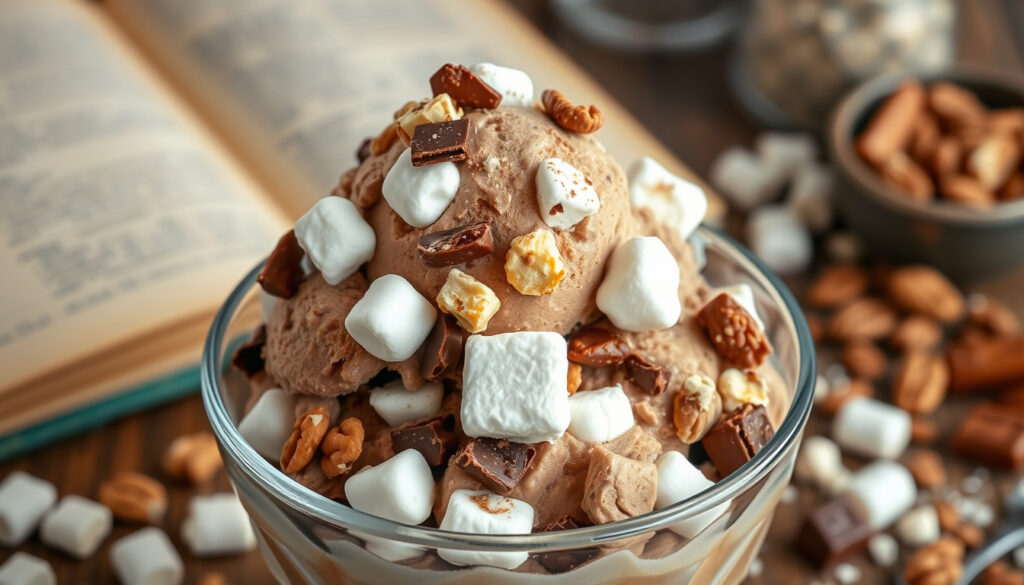
At its core, rocky road ice cream is chocolate ice cream with mix-ins. The formula that stuck combines a chocolate base with two textural elements: crunchy nuts and chewy marshmallows. Wikipedia notes it was one of the first ice cream flavors to deliberately mix multiple add-ins, launching a craze that reshaped 1920s ice cream parlors.
Traditional ingredients
The classic combination includes a chocolate ice cream base, nuts, and marshmallows. Early recipes used walnuts, which Dreyer cut with his wife’s sewing scissors before later switching to toasted almonds for mass production at Dreyer’s Grand Ice Cream. The Mental Floss history confirms Dreyer and Edy swapped walnuts for almonds during scaling, a decision still reflected in most commercial versions today.
Common variations
Modern recipes often add chocolate chips to the base, though the original 1929 formulation had none. Nuts can vary between almonds, walnuts, pecans, or peanuts depending on the brand. Lauren’s Latest documents recipe variations including toasted almonds, marshmallow fluff, and semi-sweet chocolate chips as common modern additions.
Who made the original Rocky Road ice cream?
Two competing stories exist about who invented Rocky Road. The most widely documented account credits William Dreyer, a co-founder of Dreyer’s Grand Ice Cream in Oakland, California, who created the flavor in March 1929. Dreyer used his wife’s sewing scissors to cut marshmallows into a chocolate ice cream base sprinkled with walnuts. According to Harry & David, Dreyer and business partner Joseph Edy mass-produced the flavor that same year, swapping walnuts for almonds to improve shelf stability.
Invention story
The name “Rocky Road” came after the October 1929 Wall Street Crash, when Dreyer and Edy deliberately chose a cheerful name “to give folks something to smile about in the midst of the Great Depression.” Dreyer and Edy’s company was already producing ice cream under the Edy’s brand, and they used their distribution network to spread the new flavor nationally.
Key milestones
- 1894: Fentons Creamery founded in Oakland by Eldridge Seth Fenton
- 1920: First known printed Rocky Road recipe appears in Rigby’s Reliable Candy Teacher, 13th edition (Mental Floss)
- 1929-03: Dreyer invents the flavor
- 1929-10: Wall Street Crash inspires the name
The Tasting Table reports a competing claim from Fentons Creamery, which states that their candy maker George Farren invented a Rocky Road-style flavor in the early 1900s by blending a candy bar into ice cream. Dreyer reportedly adapted Farren’s approach using almonds after the two Oakland ice cream makers discussed their respective creations. Whether Farren’s version preceded Dreyer’s remains disputed, though both stories originate from the same city.
What is the flavor of Rocky Road ice cream?
Rocky Road delivers a chocolate-forward experience with contrasting textures. The chocolate ice cream base provides richness, while nuts add crunch and marshmallows deliver chewiness. The combination creates a flavor profile that balances sweetness, bitterness from cocoa, and the saltiness of nuts.
Base profile
The foundation is always chocolate ice cream, typically made with cocoa or Dutch process cocoa for deeper flavor. Commercial brands like Häagen-Dazs and Blue Bell use premium chocolate bases, while budget options may use more air and lower cocoa content. Salt & Baker’s recipe guide documents a custard-style base using bittersweet chocolate, heavy cream, and egg yolks for professional-grade richness.
Texture and taste
The triple-texture experience defines Rocky Road’s appeal. The smooth, cold chocolate contrasts with the chewy pull of marshmallows and the satisfying crunch of nuts. This sensory combination is why Rocky Road remains one of the top-selling ice cream flavors decades after its creation. Harry & David notes that Rocky Road launched the mix-in craze in 1920s ice cream parlors, establishing the template for countless subsequent flavor combinations.
Rocky Road’s staying power comes from its intentional contrast: chocolate’s richness, marshmallows’ chew, and nuts’ crunch work together rather than competing. This textural balance is why it predated the modern mix-in trend by nearly a century.
What are the ingredients for Rocky Road?
Homemade Rocky Road requires two components: the chocolate ice cream base and the add-ins. Store-bought versions simplify this, but making it at home allows control over quality and texture.
Homemade list
- Heavy cream and whole milk for the base
- Unsweetened cocoa powder or Dutch process cocoa
- Egg yolks for custard-style versions
- Sugar (typically ¾ to 1 cup for a standard batch)
- Vanilla and almond extract for flavor depth
- Semi-sweet chocolate chips or grated chocolate
- Nuts (almonds, walnuts, pecans, or peanuts)
- Miniature marshmallows or marshmallow fluff
Barefeet In The Kitchen documents a complete recipe using ¾ cup sugar, ⅓ cup Dutch process cocoa, ¼ teaspoon salt, 1 cup whole milk, 2 cups heavy cream, 8 ounces bittersweet chocolate, and 1 teaspoon vanilla, with add-ins of semi-sweet chocolate chips, sliced almonds, and miniature marshmallows folded in after churning.
Store-bought examples
Major brands like Häagen-Dazs, Blue Bell, and Baskin-Robbins all produce Rocky Road variants. Häagen-Dazs uses chocolate ice cream with almonds and marshmallow pieces. Blue Bell’s version includes chocolate chunks alongside traditional mix-ins. Baskin-Robbins offers seasonal variations and limited editions featuring Rocky Road as a base.
Commercial Rocky Road formulations have largely standardized on almonds over walnuts, diverging from Dreyer’s original 1929 recipe. If you prefer the authentic historical version, homemade is the only reliable option.
How to make Rocky Road 3 ingredients?
The simplest Rocky Road recipes require just three core ingredients beyond the basic ice cream base. This approach prioritizes simplicity over custard-style depth but produces authentic results in hours rather than a full day.
Simple recipe steps
- Whip 2 cups heavy cream to stiff peaks
- Fold in ¾ cup sweetened condensed milk and ½ cup cocoa powder until smooth
- Add ½ cup grated chocolate and ½ cup chopped almonds
- Fold in ¾ cup miniature marshmallows
- Pour into a loaf pan and freeze for at least 6 hours
Recipe52’s no-churn method uses this exact approach: heavy cream provides the structure, condensed milk adds sweetness and body without cooking a custard, and cocoa creates the chocolate flavor. The add-ins go in before freezing and stay suspended throughout.
No-churn method
The no-churn technique eliminates the need for an ice cream maker entirely. Lauren’s Latest recommends folding add-ins into whipped cream rather than blending them in, which prevents the marshmallows from breaking apart. The key is folding gently — overmixing deflates the cream and produces icy results. No-churn Rocky Road typically takes 6-8 hours to set properly, compared to 4-6 hours for churned versions.
No-churn recipes have a narrower texture window — serve within 3-4 days for best quality, as the higher air content degrades faster than traditional churned ice cream. Commercial pints last months because they use stabilizers and lower air ratios.
Rocky Road timeline
The flavor’s history spans more than a century, with competing claims from two Oakland institutions. Understanding the timeline clarifies why the invention story remains contested.
Key milestones in the Rocky Road timeline trace its evolution from an Australian confection to its American ice cream incarnation.
| Period | Event | Source |
|---|---|---|
| 1853 | Australian Rocky Road confection emerges for gold rush settlers | Cheesecake.com |
| 1894 | Fentons Creamery founded in Oakland | Mental Floss |
| 1920 | First printed Rocky Road recipe in Rigby’s Reliable Candy Teacher | Mental Floss |
| October 1929 | William Dreyer creates Rocky Road at Dreyer’s Grand Ice Cream | Wikipedia |
| October 1929 | Wall Street Crash inspires the “Rocky Road” name | Wikipedia |
The Australian connection remains murky. Harry & David reports that the Australian version was a chocolate bar containing spoiled sweets, nuts, and dried fruits marketed to miners during the 1850s gold rush. Whether Dreyer or Farren knew about this earlier confection when developing their ice cream version is unclear — no documented link exists between the Australian snack and the American ice cream invention.
Confirmed vs. unclear
Confirmed
- Chocolate base with nuts and marshmallows per Wikipedia
- William Dreyer created the flavor in 1929
- Name chosen after October 1929 Wall Street Crash
- Original recipe used walnuts, later switched to almonds
- Rocky Road launched the ice cream mix-in craze
Unclear
- Whether George Farren’s Fentons version preceded Dreyer’s
- Exact calorie counts vary by brand and serving size
- Whether Australian 1853 confection influenced US version
- No quantitative brand market share data available
What people say
Dreyer and Edy gave the flavor its current name “to give folks something to smile about in the midst of the Great Depression.”
— Wikipedia (Encyclopedia entry on Rocky Road ice cream)
Dreyer used his wife’s sewing scissors to dice a marshmallow into a chocolate ice cream base sprinkled with walnuts.
— Harry & David (Food publication covering Rocky Road’s history)
To create this new recipe, Dreyer mixed marshmallows and walnuts (that would soon be replaced with almonds) into chocolate ice cream.
— Tasting Table (Food media covering Fentons claim)
Related reading: Flat White vs Latte · Extra Virgin Olive Oil NZ
Rocky Road ice cream’s chunky mix of chocolate, nuts, and marshmallows directly echoes the classic rocky road recipe cherished in holiday traditions worldwide.
Frequently asked questions
What is traditionally in rocky road ice cream?
Traditional Rocky Road contains chocolate ice cream with nuts (typically almonds) and marshmallows mixed in. The original 1929 version used walnuts, which Dreyer later switched to toasted almonds for mass production stability.
What do Americans call Rocky Road?
Americans call it “Rocky Road ice cream” or simply “Rocky Road.” The name references the Great Depression’s “rough road” ahead after the 1929 Wall Street Crash, chosen deliberately to offer consumers something cheerful during hard times.
What’s the unhealthiest ice cream?
Rocky Road frequently appears on “unhealthiest ice cream” lists due to its chocolate base combined with sugar-laden marshmallows and high-fat nuts. A typical serving contains 250-350 calories, with premium brands like Häagen-Dazs running higher due to higher butterfat content.
What is the unhealthiest ice cream to eat?
Full-fat Rocky Road, particularly premium versions with higher butterfat percentages, ranks among the highest-calorie options. Ben & Jerry’s Chubby Hubby (a Rocky Road variant) and Häagen-Dazs Rocky Road contain 260-300 calories per half-cup serving with 16-18 grams of fat.
Rocky Road ice cream origin?
Rocky Road ice cream originated in Oakland, California in March 1929, created by William Dreyer of Dreyer’s Grand Ice Cream. The name came after the October 1929 Wall Street Crash as a deliberately cheerful choice during the Great Depression.
Rocky Road ice cream inventor?
William Dreyer is the most widely documented inventor, though Fentons Creamery claims their candy maker George Farren created a similar flavor earlier. Dreyer used his wife’s sewing scissors to cut marshmallows into chocolate ice cream, then partnered with Joseph Edy to mass-produce the flavor.
Rocky Road Ice Cream price?
Store-bought Rocky Road typically costs $4-7 per pint depending on brand. Häagen-Dazs runs $6-7, Blue Bell around $4-5, and store brands $3-4. Premium artisanal versions from specialty shops run $8-12 per pint.
Rocky road ice cream calories?
A typical half-cup serving of Rocky Road ice cream contains 250-350 calories. Premium brands like Häagen-Dazs run 280-300 calories per serving, while light versions may be 150-180 calories. The nuts and marshmallows add significant calories compared to plain chocolate ice cream.
Rocky Road remains one of American ice cream’s most enduring flavors precisely because it was designed to be more than dessert — it was comfort food during an economic catastrophe. The chocolate-marshmallow-nut combination succeeded because it offered texture, sweetness, and a psychological boost in one scoop. For anyone craving that same combination today, the homemade route remains straightforward: three core ingredients, no equipment required, and a result that honors the original 1929 invention. For ice cream lovers in the US and beyond, the choice is clear: try the no-churn version at home, or pick up a pint from Blue Bell or Häagen-Dazs — both deliver the classic contrast that has made Rocky Road a century-spanning favorite.
More related posts
 Wooden Venetian Blinds NZ: Prices, Retailers & Guide
 How to Cut Your Own Hair: Pro Tips for Home Cuts
 Galaxy A21s to Buy: Prices, Reviews & Ireland Deals
 India Women vs New Zealand Women: Head-to-Head & Scorecard
 NZ Prime Minister List: All 42 Leaders (1856–2025)
 Trade Me Horses for Sale: Costs, Breeds & Beginner Tips
 IND vs AUS ODI 2025: Schedule, Venues, Live Streaming & More
 AZ Alkmaar vs Tottenham 2025: Score, Highlights, Stats & Lineups
