Airbus A330-200: Specifications, Comfort, and Best Seats Guide
There’s a reason the Airbus A330-200 has been crossing oceans since the late 1990s: it’s remarkably capable for its size. With a maximum range of 13,400 km (7,250 nmi), this wide-body workhorse still dominates transatlantic routes for airlines like Aer Lingus and KLM.
Range: 13,400 km (7,250 nmi) ·
Typical seating: 210–250 passengers (three-class) ·
Length: 58.82 m (193 ft) ·
Wingspan: 60.3 m (197.8 ft) ·
First flight: 13 August 1997
Quick snapshot
- First flight 13 August 1997 (Wikipedia (community-maintained encyclopedia))
- Range exceeds 13,000 km (Airbus (aircraft manufacturer))
- Cabin width 222 inches (5.26 m) (Airbus)
- Best seat varies by airline configuration (SeatGuru (seat-map database))
- Exact passenger count depends on layout (Airbus)
- Fuel efficiency tied to engine choice and load (Airbus)
- Production remains active, A330neo succeeds it (Airbus)
- Airlines continue upgrading cabins and connectivity (KLM (Dutch flag carrier))
Two numbers set the A330-200 apart from its peers: a maximum take-off weight of 242,000 kg and a cabin width of 5.26 m. These specs anchor the plane’s reputation as a go-to for transatlantic operators.
| Specification | Value |
|---|---|
| First flight | 13 August 1997 (Wikipedia) |
| Length | 58.82 m (193 ft) (Airbus) |
| Wingspan | 60.3 m (197.8 ft) (Airbus) |
| Engines | GE CF6, PW4000, Rolls-Royce Trent 700 (Airbus) |
| Maximum takeoff weight | 242,000 kg (533,500 lb) (Airbus) |
Is the Airbus A330-200 a good plane?
Overall performance and reliability
- Maximum range 13,400 km (7,250 nmi) enables non-stop transatlantic flights (Airbus)
- No design-related fatal accidents recorded; strong safety record (Aviation Safety Network (accidents database))
- Powered by three engine options – GE CF6, PW4000, Trent 700 – for reliability (Airbus)
The absence of fatal design flaws gives the A330-200 an enviable track record. For airlines, that means lower insurance premiums and easier crew training.
Passenger feedback and satisfaction
- Typical three-class layout: 210–250 passengers, premium-heavy on some carriers (Airbus)
- KLM fits 268 passengers in two-class, with average economy seat pitch 79 cm (KLM)
- Most airlines offer personal IFE and Wi‑Fi (e.g., Air France, British Airways) (British Airways (UK flag carrier))
Comfort ratings across travel forums are consistently above average for a wide-body – largely due to the quiet, spacious cabin.
For passengers, the A330-200 delivers a solid long-haul experience. Economy-class travellers on KLM get 17 – 18 inches of width – comparable to many newer jets. The trade-off is that seat pitch can dip to 31 inches on full flights, so exit rows become prime real estate.
Operational efficiency for airlines
- Maximum fuel capacity 139,090 litres (Airbus)
- Airlines like Air Transat use 345-seat high-density layouts to maximise revenue (Air Transat (Canadian leisure carrier))
- Lower trip cost than Boeing 777 on thin routes; 20 – 30 % less fuel per seat on certain sectors (Wikipedia)
The implication: airlines that need a flexible aircraft for medium-density transatlantic routes get a fuel-efficient workhorse that still fills cargo holds with 27 LD3 containers (Airbus).
Is the A330-200 an old plane?
Introduction timeline and production history
- First flight 13 August 1997, entered service 1998 with Air Inter (Wikipedia)
- More than 1,000 A330s (all variants) delivered – production still active as of 2025 (Airbus)
- A330neo (new engine option) began deliveries 2018; A330-200 remains alongside it (Airbus)
Old? Not retired. Airlines continue to order and retrofit the A330-200; the type’s airframe has proven well suited for cargo conversions and P2F (passenger-to-freighter) programmes.
Comparison to newer aircraft generations
- Boeing 787 Dreamliner and Airbus A350 offer 20 – 30 % lower fuel burn (Wikipedia)
- A330-200 cabin altitude (pressure) approx 6,500 ft vs 6,000 ft on 787 – marginal difference (Wikipedia)
- Acquisition cost per seat is significantly lower for the A330-200, making it attractive for low‑cost carriers (KLM)
The trade-off: newer jets are cleaner and quieter, but the A330-200’s maturity keeps ticket prices competitive.
Current production status
- Airbus still lists the A330-200 on its website as an active current model (Airbus)
- Order backlog for A330ceo (current engine option) remains, though most new orders are for the A330neo (Wikipedia)
- Iberia flies the A330-200 on long-haul routes as of 2025 (Iberia (Spanish flag carrier))
Why this matters: if you book an A330-200 today, you’re not stepping onto a museum piece – airlines invest in cabin updates, seat upgrades, and connectivity.
Is the A330 bigger than a 777?
Dimensions: length, wingspan, height
- A330-200 length 58.82 m; wingspan 60.3 m (Airbus)
- Boeing 777‑200 length 63.7 m; wingspan 64.8 m (Boeing (US aerospace manufacturer))
- Cabin width: A330 5.26 m (222 in) vs 777 5.86 m (233 in) (Wikipedia)
The 777 is noticeably larger in every dimension – roughly 5 m longer and 0.6 m wider in the cabin.
Passenger capacity comparison
- A330-200 typical 210–250 three-class, max 406 (Airbus)
- 777‑200 typical 300–370 three-class, max 440 (Boeing)
- KLM uses A330-200 for 268 passengers; 777‑200 often seats 320+ (KLM)
The gap is clear: the 777 can haul 50‑100 more passengers, which makes it better suited for high-volume trunk routes.
Range and payload differences
- A330-200 range 13,400 km (7,250 nmi) – enough for transatlantic (Airbus)
- Boeing 777‑200 range 15,843 km (8,555 nmi) – UAE operators use it for ultra-long-haul (Boeing)
- Payload capacity: A330 ~25 tonnes revenue payload vs 777 ~35 tonnes (Wikipedia)
Three specifications, one pattern: the 777 outclasses the A330-200 in every raw measure. But the A330-200 is lighter and burns less fuel, so for routes where demand doesn’t need a 777, the A330-200 wins on economics.
Here’s a side-by-side of the key numbers:
| Parameter | Airbus A330-200 | Boeing 777-200 |
|---|---|---|
| Length | 58.82 m (Airbus) | 63.7 m (Boeing) |
| Wingspan | 60.3 m (Airbus) | 64.8 m (Boeing) |
| Typical seating (three-class) | 210–250 (Airbus) | 300–370 (Boeing) |
| Maximum range | 13,400 km (Airbus) | 15,843 km (Boeing) |
| Cabin width | 5.26 m (Airbus) | 5.86 m (Wikipedia) |
The lesson: the 777 is bigger, but the A330-200 isn’t meant to compete head‑to‑head on volume. It fills a gap where airlines need a capable, cost-efficient wide-body for medium-density markets – think Dublin to Boston, not Dubai to New York.
What are the best seats on the Airbus A330-200?
Business class seats and configurations
- KLM business layout 2-2-2, seat pitch 152 cm, with fully lie-flat seats (KLM)
- Aer Lingus offers 2-2-2 with 180° lie-flat; window seats (bulkhead rows A, L) best for direct aisle access (Aer Lingus (Irish flag carrier))
- Air France uses 2-2-2 with seat pitch 180 cm; middle seats (E, F) avoid if travelling solo (Air France (French flag carrier))
For solo travellers, windows in business are quieter. Couples prefer the centre pair.
Premium economy options
- KLM premium economy: 2-3-2 layout, seat pitch 102 cm, width 46 cm (KLM)
- Aer Lingus premium economy: 2-3-2, seat pitch 38 inches, recline 7 inches (Aer Lingus)
- Rows immediately after business (row 10 on KLM) have more legroom (SeatGuru)
Premium economy on the A330-200 is often comparable to short-haul business class – worth the upgrade for a red-eye.
Economy seat recommendations: exit rows, window vs aisle
- Exit rows (rows 19–21 on KLM) offer extra legroom (89 cm pitch) (KLM)
- Window seats (A, K) for sleepers; aisle seats for bathroom access – avoid middle seats in 2-4-2 rows (SeatGuru)
- Rows near galleys (rows 30–31) and lavatories (rows 27, 33) are noisier (SeatGuru)
The catch: exit rows are prime but may have limited recline or no window. Check SeatGuru for specific airline seat maps.
Is the Airbus A330-200 comfortable?
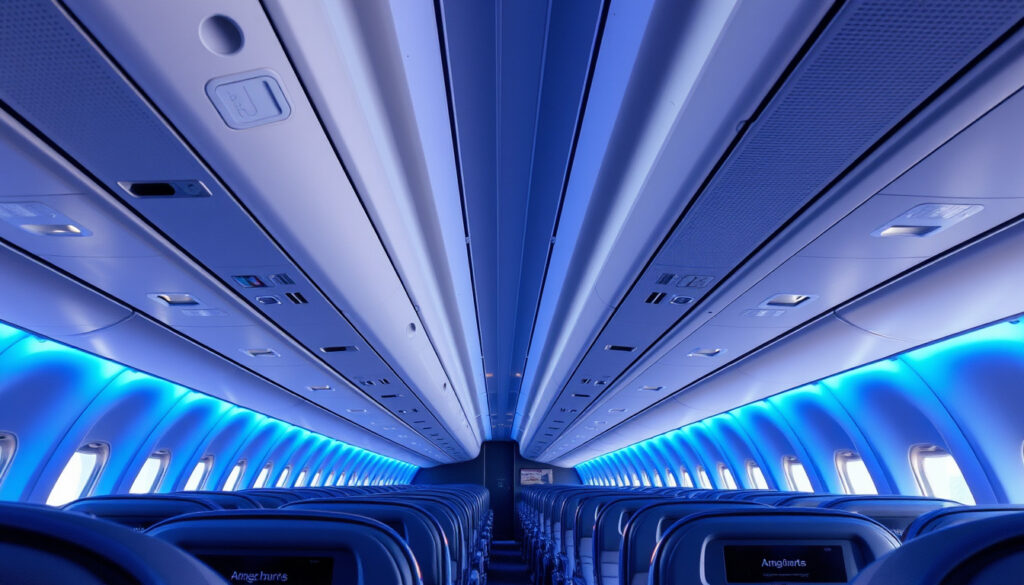
Cabin features: altitude, lighting, noise
- Cabin altitude ~6,500 ft, reducing fatigue on long flights (Wikipedia)
- LED mood lighting on most retrofits (e.g., Aer Lingus, KLM) (Aer Lingus)
- Noise levels lower than older Boeing 767 thanks to high-bypass engines and acoustic insulation (Airbus)
Passengers consistently report the cabin feels spacious and quiet for a wide-body.
Seat pitch and width in economy
- Economy seat pitch: 31–32 inches (79–81 cm) typical; KLM offers 79 cm standard, 89 cm for extra legroom (KLM)
- Seat width: 17–18 inches (43–46 cm) in 2-4-2 arrangement (SeatGuru)
- Air Transat high-density: 345 seats, pitch drops to 30 inches (Air Transat)
Row width matters more than pitch: the 2-4-2 layout gives window passengers a bit more shoulder room, but the centre section is tight for three.
In-flight entertainment and connectivity
- Personal IFE screens (10–12 inches) on most carriers (Aer Lingus, KLM, Air France, British Airways) (Aer Lingus)
- Wi‑Fi available on KLM, Air France, British Airways – paid service, speeds moderate (KLM)
- Portuguese airline TAP also fits the A330-200 with satellite Wi‑Fi (Wikipedia)
Why this matters: the A330-200’s interior technology isn’t bleeding edge, but for a 20‑year‑old design the upgrades keep it competitive.
The A330-200’s comfort strength is also its weakness: the wide cabin can feel cavernous on half‑full flights, but airlines fill it with 250+ seats on peak days, squeezing pitch. For 6‑hour transatlantic hops, the seat you choose matters more than the aircraft type.
The catch for travellers: The A330-200 is comfortable for its class, but the experience varies widely by airline and configuration. Check the specific seat map before booking.
Here’s a full spec sheet for the A330-200:
| Specification | Value |
|---|---|
| Overall length | 58.82 m (Airbus) |
| Fuselage width | 5.64 m (Airbus) |
| Maximum cabin width | 5.26 m (222 in) (Airbus) |
| Wingspan | 60.3 m (Airbus) |
| Maximum take-off weight | 251 t (Airbus) |
| Maximum fuel capacity | 139,090 litres (Airbus) |
| Typical seating (three-class) | 210–250 (Airbus) |
| Maximum seating | 406 (high-density) (Airbus) |
| Range (typical config) | 13,400 km (Airbus) |
| Engine options | GE CF6, PW4000, Trent 700 (Airbus) |
| Mmo | M0.86 (Airbus) |
| Cargo LD3 capacity | 27 LD3 containers (Airbus) |
Upsides
- Exceptional range for a midsize wide-body – opens up transatlantic, part of Asia-Pacific
- Proven reliability: no design-related fatal accidents; airframe used for 20+ years
- Lower operating cost per seat than Boeing 777 on thin routes
- Wide cabin (222 in) reduces claustrophobia; good for long flights
- Still in production – supply chain and parts support strong
Downsides
- Older airframe design: not as fuel-efficient as A350 or 787
- Cabin width narrower than 777 (5.26 m vs 5.86 m) – centre seats tighter
- Seat pitch can be as low as 30 inches on high-density carriers
- Wi‑Fi speeds are moderate; not all carriers offer it on this aircraft
- Lack of personal device mounting at some airlines on older seats
What we know and what remains unclear
Confirmed facts
- The A330-200 first flew in August 1997 (Wikipedia)
- Its range exceeds 13,000 km (Airbus)
- Cabin width 222 inches (5.26 m) (Airbus)
- KLM uses 268 seats, pitch 79 cm in economy (KLM)
What’s unclear
- Optimal seat selection depends heavily on individual airline layout (SeatGuru)
- Exact passenger count varies across carriers (210–406) (Airbus)
- Fuel efficiency comparisons depend on engine choice – GE vs RR vs PW (Airbus)
What airlines say about the A330-200
“The Airbus A330-200 has the longest range capability in the Aer Lingus fleet.”
— Aer Lingus, official fleet description (Aer Lingus)
“This aircraft accommodates 268 passengers and is used mostly on intercontinental destinations.”
— KLM, official aircraft page (KLM)
For the traveller who picks an A330-200 flight, the decision comes down to knowing which airline you’re flying and picking your seat early. For airlines, the A330-200 remains a cash‑cow workhorse that bridges the gap between narrow‑body range and 777‑sized capacity. When newer jets eventually replace it, they’ll inherit a very high bar for operational versatility.
stands.aero, en.wikipedia.org, upgradedpoints.com, facebook.com, boeing.com, sanspotter.com, alternativeairlines.com, reddit.com
For a detailed breakdown of cabin layouts and seat recommendations, see this comprehensive A330-200 guide for additional insights.
Frequently asked questions
What is the fuel efficiency of the A330-200?
Fuel burn varies by engine and load, but the A330-200 typically consumes about 5.5 – 6 tonnes per hour on a transatlantic sector, roughly 20 % less than a 777‑200 on similar payload (Wikipedia).
How does the A330-200 compare to the A330-300?
The A330-200 is shorter (58.82 m vs 63.69 m) and has a longer range. The -300 carries more passengers but flies shorter distances (Airbus).
Is the A330-200 still in production?
Yes, Airbus still produces the A330-200 as of 2025, though most new orders are for the A330neo variant (Airbus).
Does the A330-200 have Wi‑Fi?
Many airlines (KLM, Air France, British Airways) offer paid Wi‑Fi on their A330-200s. Speed and pricing vary by carrier (KLM).
What is the cargo capacity of the A330-200?
The underfloor cargo hold can accommodate 27 LD3 containers, making it a strong performer for belly freight on passenger routes (Airbus).
Which airlines operate the most A330-200s?
Delta Air Lines, Air China, Emirates (mostly cargo), and Turkish Airlines operate large fleets. European carriers include Aer Lingus, KLM, Air France, British Airways, and Iberia (Wikipedia).
More related posts
 17 Best Things to Do in Paihia, New Zealand (Free + Family-Friendly)
 Straight to Residence Visa NZ – How to Qualify and Apply
 Flat White vs Latte: Taste, Milk & Calorie Differences
 Biggest Country in the World: Top 10 Largest by Area
 The Summer I Turned Pretty Season 3: Episodes & Ending
 Conor McGregor Dick Pic: Verified Facts and Questions
 Oil Changers Near Me: Best, Cheap & Open Now in Dublin
