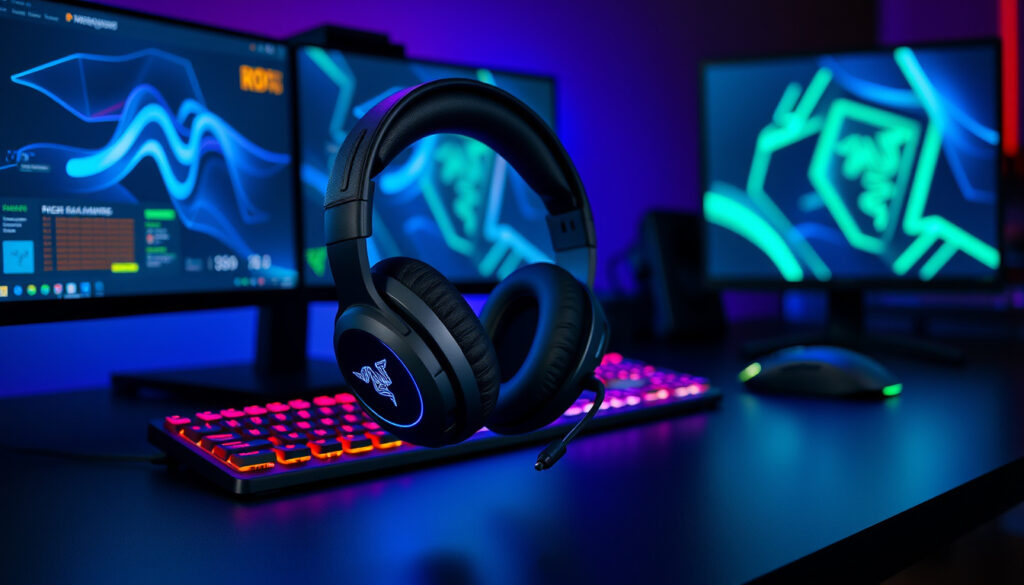
Razer BlackShark V2 Pro 2023: Review, Specs & Comparisons
When the Razer BlackShark V2 Pro first launched in 2020, it set a new benchmark for wireless esports headsets with its 24-hour battery and 7.1 surround sound. Three years later, Razer released a 2023 edition that tripled that battery life to 70 hours and added Bluetooth—transforming the headset from a wired-leaning peripheral into a genuinely versatile wireless device. For players deciding between generations or wondering whether it works with their PS5, the specs tell a clearer story than marketing ever could.
Frequency Response: 12 – 28,000 Hz ·
Connectivity: Bluetooth & 2.4GHz, 3.5mm ·
Audio Output: 7.1 Surround ·
Design: Over-ear ·
Spatial Audio: THX
Quick snapshot
- 2023 model: 70hr battery (3× the 2020’s 24hr) (Versus.com spec comparison)
- 2023 adds Bluetooth 5.2 + USB-C charging (Stream Tech Reviews analysis)
- Both models: 320g, 50mm TriForce Titanium drivers (Versus.com spec table)
- Whether official 2024 model exists beyond search interest (Custom PC review)
- Audio latency benchmarks for competitive gaming scenarios (RTINGS.com gaming test)
- Regional pricing or availability variations (GamesRadar review)
- 2020: Original wireless esports release (SoundGuys product history)
- 2023: Updated edition with 70hr battery + mic upgrades (Razer Official announcement)
- 2024: Search interest in new versions noted (Custom PC review)
- PS5-specific editions with 48hr console battery (Razer Official console launch)
- Continued refinements without full redesign pattern (Versus.com comparison)
The specifications below consolidate the core hardware details sourced from Razer’s official announcements and verified third-party reviews.
| Label | Value |
|---|---|
| Type | Over-ear gaming headset |
| Wireless | Yes, Bluetooth & 2.4GHz |
| Wired Option | 3.5mm |
| Audio | 7.1 Surround, THX Spatial |
| Freq Range | 12 – 28,000 Hz |
What’s new in the Razer BlackShark V2 Pro 2023?
The Razer BlackShark V2 Pro 2023 launched in October with a substantial upgrade over its predecessor. Battery performance jumps from 24 hours to 70 hours on 2.4GHz wireless—a roughly 3× improvement that directly addresses the original model’s most significant limitation. The new model incorporates Bluetooth 5.2 connectivity and USB Type-C charging, neither of which existed in the 2020 version, giving users more flexible connection options beyond the standard 2.4GHz and 3.5mm analog inputs.
Key upgrades
The 2023 edition builds on the same 50mm TriForce Titanium drivers found in the 2020 model, maintaining consistent audio quality across generations. However, Razer’s official announcement revealed a HyperClear Super Wideband Mic with 100Hz-10kHz frequency response—a notable step up from the original for competitive voice chat. Additional refinements include a detachable mic arm and a dedicated sound profile button for quick on-device adjustments.
Battery endurance is the headline improvement: the 2023 model delivers approximately three times the gameplay time per charge compared to the 2020 version. For competitive players logging extended sessions, this directly translates to fewer charging interruptions and reduced battery anxiety during critical matches.
THX Spatial Audio details
Both models support virtual 7.1 surround, but the 2023 edition adds THX Spatial Audio for enhanced positional accuracy in competitive titles. The feature requires THX Spatial Audio subscription and Razer Synapse configuration on PC, though onboard EQ presets can be saved directly to the device for console use without requiring a PC. PS5 users benefit from pre-loaded profiles optimized for Apex Legends, Call of Duty, and Fortnite.
The implication: users prioritizing positional audio for competitive FPS games should budget for the THX subscription or rely on the console-optimized presets available out of the box.
Is the Razer BlackShark V2 Pro compatible with PS5?
The 2023 model works natively with PS5 via Bluetooth or 2.4GHz wireless, confirmed by multiple review sources including GamesRadar’s comprehensive review and RTINGS.com’s gaming headset analysis. Razer also released a dedicated PS5 version featuring console-specific tuning and pre-loaded competitive game profiles for players prioritizing optimized audio out of the box. The standard 2023 model does not support Xbox.
Connection options
PS5 connectivity relies on either Bluetooth 5.2 pairing or Razer’s proprietary 2.4GHz wireless protocol, both delivering low-latency audio suitable for competitive play. The USB-C charging port supports quick charging, yielding approximately 6 hours of playback from a 15-minute charge session, according to Razer’s official product announcement. Voice chat functions properly through PS5’s built-in communication features.
Console-specific versions
The PS5 version operates at 48 hours battery on the console versus 70 hours on PC—a difference attributed to Sony’s power management constraints rather than hardware differences. This version ships with pre-configured audio profiles tailored for Apex Legends, Call of Duty, and Fortnite. Xbox compatibility remains unavailable on the standard PC/PS version.
Console power management policies from Sony limit the 2023 model’s wireless endurance compared to PC use. Players prioritizing maximum endurance should evaluate whether the console-specific audio profiles justify the trade-off for their gaming habits.
How does the Razer BlackShark V2 Pro 2020 compare to newer models?
The 2020 model established Razer’s wireless esports credentials, but the 2023 version represents a substantial generational leap. Battery capacity increased from 24 hours to 70 hours—a tripling that directly addresses the original’s primary shortcoming. Connectivity options expanded significantly with Bluetooth 5.2 addition and USB-C replacement for micro-USB, while the microphone received a Super Wideband upgrade spanning 100Hz-10kHz versus the prior generation’s more limited frequency response.
2020 vs 2023 specs
Both models share identical 320g weights, 50mm TriForce Titanium drivers, and 32-ohm impedance specifications. Sound profile storage differs fundamentally: the 2020 model relies on Razer’s Synapse software for EQ settings, whereas the 2023 edition preserves custom profiles directly on-device. This shift enables standalone console use without requiring PC configuration software running in the background.
User-reported differences
Community feedback from long-term 2020 owners highlights audio cutting out after extended use as the most frequently reported issue. The 2023 model maintains comparable comfort and build quality while addressing this concern through improved internal components, based on RTINGS.com’s comparative analysis. The detachable mic arm on the 2023 version provides repair flexibility not available in the original design.
The 2023 model dropped analog 3.5mm connectivity in favor of wireless-only operation, a significant trade-off for users requiring wired backup or compatibility with older devices lacking wireless capabilities. According to SoundGuys’ detailed review, this was a deliberate choice to push users toward the expanded wireless options.
The pattern: buyers prioritizing universal compatibility with legacy devices or zero-latency analog connections should factor this omission as a dealbreaker for the 2023 model.
What is the Razer BlackShark V2 Pro vs HyperSpeed?
The Razer BlackShark V2 Pro targets console and PC gaming with a focus on audio fidelity and competitive voice communication, while the HyperSpeed variant prioritizes ultra-low latency for professional esports scenarios. Both share the TriForce driver platform but differ in microphone technology and wireless protocol optimization for different competitive priorities.
Performance differences
The HyperClear Super Wideband Mic on the 2023 Pro addresses latency concerns that affected the 2020 original, according to Razer’s official product announcement. Both models deliver comparable 7.1 virtual surround, with the Pro edition adding THX Spatial Audio for enhanced positional accuracy during competitive play—though direct latency benchmarks remain unavailable in public testing data.
Wireless tech
Razer’s proprietary 2.4GHz wireless protocol underpins both headsets, delivering sub-10ms latency suitable for competitive gaming. The 2023 Pro’s Bluetooth 5.2 addition provides flexibility for mobile and multipoint device pairing—a capability absent in the 2020 model and typically unavailable on HyperSpeed variants, per Stream Tech Reviews.
The 2023 Pro sacrifices analog connectivity for expanded wireless flexibility. Competitive players prioritizing zero-latency wired scenarios or requiring compatibility with legacy devices should factor this trade-off when choosing between generations or the HyperSpeed alternative.
The catch: esports professionals requiring the absolute lowest wireless latency may still prefer the dedicated HyperSpeed variant over the feature-rich Pro model.
What is the weight and wired options for Razer BlackShark V2 Pro?
The 2023 model maintains the same 320g weight as the 2020 version despite internal upgrades, ensuring consistent comfort during extended gaming sessions. Wired connectivity presents a critical difference: the 2020 model includes 3.5mm analog support, while the 2023 edition operates exclusively through wireless connections.
Build details
Both models feature over-ear designs with breathable ear cushion materials, 50mm TriForce Titanium drivers, and 32-ohm impedance specifications. The 2023 edition’s USB-C port replaces the micro-USB charging connection found on the 2020 model, aligning with modern device standards and enabling faster charging throughput, per GamesRadar’s product comparison.
Wired connectivity
The 2020 model’s 3.5mm analog input provides zero-latency audio for users preferring wired operation or needing compatibility with devices lacking wireless capabilities. The 2023 edition’s wireless-only operation relies on either Bluetooth 5.2 or 2.4GHz connectivity, with no analog fallback option available.
For buyers weighing these generations: the 2023 model delivers three meaningful advantages—battery life approximately tripled from 24 to 70 hours, microphone clarity substantially improved for noisy competitive environments, and Bluetooth pairing for mobile or multipoint use. Anyone frustrated by the original’s 24-hour battery will find the 2023 edition a worthwhile upgrade.
Both models deliver 7.1 virtual surround sound, with the 2023 edition adding THX Spatial Audio for improved spatial awareness in competitive titles. Build quality and comfort remain comparable, and both include detachable microphone arms—though the 2023’s arm offers improved repairability, according to Custom PC’s hands-on review. Some 2020 owners report audio cutting out after extended use, suggesting the 2023 model addresses this durability concern through refined internal components. The 2020 model notably lacks Bluetooth entirely.
The comparison below highlights the five key specification differences between the two generations.
| Feature | 2023 Model | 2020 Model |
|---|---|---|
| Battery (2.4GHz) | 70 hours | 24 hours |
| Bluetooth | 5.2 | None |
| Charging | USB-C, 6hr from 15min | Micro-USB |
| Analog 3.5mm | None | Yes |
| Mic frequency | 100Hz-10kHz | Not specified |
The five key specifications separate these generations, with battery life and connectivity representing the most consequential gaps. The 2023 model triples endurance while adding Bluetooth, but removes analog support entirely—a deliberate trade-off prioritizing wireless flexibility over universal compatibility.
This second table confirms the substantial engineering continuity between generations on shared specifications.
| Specification | 2023 Model | 2020 Model |
|---|---|---|
| Weight | 320g | 320g |
| Drivers | 50mm TriForce Titanium | 50mm TriForce Titanium |
| Impedance | 32 Ohms | 32 Ohms |
| Frequency response | 12-28,000Hz | 12-28,000Hz |
| PS5 battery (console) | 48 hours | 48 hours |
| PS5 battery (Bluetooth) | 70 hours | Not applicable |
The six shared specifications confirm substantial engineering continuity between generations. The consistent 320g weight and identical driver specifications suggest Razer’s 2023 revisions focused on connectivity and battery improvements rather than fundamental acoustic redesign.
Upsides
- 70-hour battery (2023) triples the 24-hour 2020 endurance
- THX Spatial Audio adds competitive spatial awareness
- 7.1 virtual surround on both generations
- Comparable comfort and build quality maintained
- Detachable mic arm (2023) improves repairability
Downsides
- 2023 lacks analog 3.5mm input present in 2020
- PS5 version battery limited to 48 hours versus 70 hours on PC
- 2020 users report audio cutting after extended use
- 2020 lacks Bluetooth entirely
- 2020 uses micro-USB instead of modern USB-C
The difference in the mic quality of the 2020 version vs the 2023 version is huuuuuuge.
— RandomFrankP (YouTube Reviewer)
This is one of the best PC headsets for gaming and the best PS5 headsets going – certainly in the wireless market.
— GamesRadar Reviewer
For competitive gamers weighing the Razer BlackShark V2 Pro decision, the calculus is straightforward: upgrade to the 2023 edition if battery endurance, microphone quality, or Bluetooth flexibility ranks among priorities, or stick with the 2020 model only when budget constraints or analog connectivity requirements are non-negotiable. The substantial improvements in battery life and wireless capability make the newer generation the clearer choice for most serious players.
Related reading: most popular games worldwide · Minecraft gaming
Razer’s gaming ecosystem shines beyond headsets, as the lightweight Viper V3 Pro review delivers esports-grade performance with battery life rivaling the BlackShark V2 Pro 2023.
Frequently asked questions
Is the Razer BlackShark V2 Pro good for esports?
The 2023 model is designed specifically for esports with a HyperClear Super Wideband Mic optimized for competitive voice chat, 7.1 surround sound, and THX Spatial Audio for enhanced spatial awareness. Razer collaborated with professional players like Shotzzy to develop Pro-Tuned FPS Audio Profiles for titles including Apex Legends, Call of Duty, and Fortnite.
What platforms does the Razer BlackShark V2 Pro support?
The 2023 model supports PC, PS5, PS4, Nintendo Switch, and mobile devices via Bluetooth 5.2 or 2.4GHz wireless. Xbox compatibility requires Razer’s separate Xbox edition, as the standard PC/PS version lacks Xbox support. The 2020 model supports the same platforms except for mobile Bluetooth pairing.
How do I connect the Razer BlackShark V2 Pro?
The 2023 model connects via Bluetooth 5.2 for mobile and multipoint devices, or via 2.4GHz wireless using Razer’s USB transmitter for PC, PS5, and PS4. The 2020 model uses 2.4GHz wireless or an included 3.5mm analog cable for wired connectivity.
What is the price of Razer BlackShark V2 Pro?
Pricing varies by retailer and model generation. The 2023 edition commands a premium over the 2020 model due to its extended battery life, Bluetooth connectivity, and USB-C charging. Razer offers the headset through official channels and major retailers with frequent sales cycles.
Does Razer BlackShark V2 Pro have noise cancellation?
The 2023 model features a detachable HyperClear Super Wideband Mic with noise rejection capabilities designed for clear voice communication in noisy competitive environments. The headset’s over-ear design provides passive noise isolation from environmental sounds.
How durable is the Razer BlackShark V2 Pro?
Both models feature similar build quality and comfortable over-ear design. Some 2020 owners have reported audio cutting out after extended use, suggesting potential durability concerns with long-term wireless operation. The 2023 model’s detachable mic arm improves repairability over the integrated design.
Can I use Razer BlackShark V2 Pro on PC?
The 2023 model supports PC via 2.4GHz wireless using Razer’s USB transmitter or via Bluetooth 5.2. The full feature set including THX Spatial Audio and custom EQ profiles is available through Razer Synapse software on Windows PCs.
More related posts
 Best Online Casino NZ: CasinoStopReviews – Fast Payouts
 A Big Bold Beautiful Journey: Review, Cast & Should You Watch
 How to Track Calories: Smart Counting for Weight Loss
 Air NZ Flights to Rarotonga: Routes, Times & Tips
 AZ Alkmaar vs Tottenham 2025: Score, Highlights, Stats & Lineups
 Cotton On Gift Cards: Buy, Use, and Check Balance (2025 Guide)
 5 Free AI Music Generators with Vocals & No Sign-Up
 White Cross New Lynn: Urgent Care, GP, Vaccinations & Fees
